

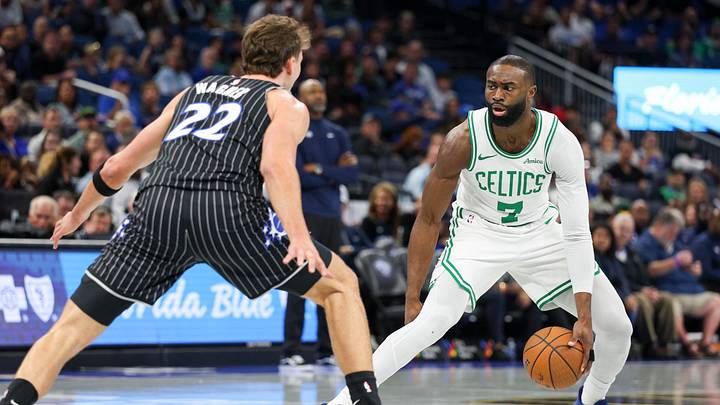
Brad Stevens went from an extremely popular man in Boston to one of the least popular overnight. At least he faced the cameras and gave his side of the story -- giving the entire NBA world something to chew on.
The shocking and sudden trade of Jaylen Brown has been justified for a lot of reasons.
The analytics crowd claims he is not as good as his counting stats might suggest. The rumor-mongering crowd claims that Brown was frustrated by inclusion in the never-ending cycle of trade rumors and could no longer stick it out with his team. Others still want to argue whether the Jayson Tatum/Jaylen Brown partnership could work, especially after Brown's breakout season.
Stevens, though, gave a simple public explanation for why the Celtics felt like it was time to trade their star and break up their core:
"When I looked at our team, and I looked at where the league was heading, looked at the way that we've finished the last couple of years, and also looked at the unbelievable way we played in the regular season in the last couple of years," Stevens said in a press conference after the trade became official Monday. "The path looked a little bit more challenging to me -- I might be wrong, not going to stand up here and be defensive about that -- but the path looked a little bit more challenging with 70 percent of our cap and such a high percent of our usage tied into two players."
There is a lot to break down on the Celtics front that you can read about at Hardwood Houdini. But there were surely a lot of management groups and teams nodding in some approval, dreading when they would have to make the same decision.
The Orlando Magic are surely one of those teams.
In the luxury tax for the first time in 15 years and flirting with the second apron, the Magic must be asking themselves to some degree whether they are good enough to compete for a championship and whether paying the tax is worth it for this roster.
Everyone around the league is wondering what the best distribution of salaries for their teams to compete at the highest levels might be. It is becoming clearer that overspending on players is much more punitive. The margin for error at the top is even smaller.
The Magic avoided these debates this offseason. They wanted to give their team a chance to be healthy. But that only increases the pressure.
As president of basketball operations Jeff Weltman has always said: The salary cap comes for everyone.
How much do you invest in your stars?
There is always pressure in the NBA. That much is abundantly true.
Orlando went from a darling pick to reach the conference finals last year to an afterthought in the Eastern Conference.
The Magic's biggest addition will be the return of a healthy Franz Wagner and the ideas of a new coach in Sean Sweeney. And the addition of Nikola Vucevic, considering their limited resources, could be a big deal for a lagging bench.
To say the least, the biggest impact for the Magic in the 2027 season will be the development and health of the team's two max players -- Paolo Banchero and Franz Wagner. If those players fulfill their potential, the Magic are contenders.
The Magic are not at a point where they need to split up their two star players. But they are facing a lot of the same issues that other star-laden teams have faced. And the Orlando Magic do not have the history of success that made the Boston Celtics' breakup so shocking.
Even with the trade, the Celtics still have more than two-thirds of their salary cap committed to Jayson Tatum and Paul George.
The Magic are not in that dire of a situation. Their cap sheet is not as top-heavy in the top two stars as the Celtics' was.
Still, Orlando has 50.3 percent of the team's salary cap committed to Paolo Banchero and Franz Wagner. The team has 74.2 percent committed to its top three players, adding Desmond Bane.
If you are wondering why the Magic have so little mobility to add to the roster, their starting lineup accounts for 104.8 percent of the salary cap. Without changes to the starting lineup, there was very little the Magic could move.
It is why, at a minimum, next summer will see the team break apart this starting lineup -- barring a championship run. The question is whether the Magic will be looking to maintain these spending levels or try to improve while decreasing their spending.
And that does not even consider a new contract for Anthony Black that is likely coming this offseason. Orlando is neck deep in tax constraints.
The issue will ultimately become about balance. How much should the Magic allocate to its two stars? That is locked in for the next four years essentially. And how much sould be redistributed to adding depth?
Boxed in by the cap
These are the questions and the debates the NBA's new CBA intended teams to ask. It made it more difficult for teams to re-up its own players and accumulate and add salary.
The Orlando Magic may have been justified in giving extensions to their players, but that has come back to cost them. They need production at the highest levels.
The Boston Celtics learned that last summer when they decided to cut salary to get out of the apron while facing a year-long absence from Jayson Tatum. They clearly still felt constrained in making meaningful moves to return to title contention.
Every team is still learning the best way to attack these new rules and restrictions. Orlando is experiencing them for the first time.
This offseason, the team was boxed in by the cap and by a determination to let this team play and get its chance. Jeff Weltman ultimately is pinning his tenure to this bet that he has enough on the roster to win and win big.
That is what being near the second apron should mean.
Regardless of the team's success or not, big decisions are on the horizon. There is no avoiding it.
Like Brad Stevens, Jeff Weltman is managing a difficult cap situation as he tries to figure out how to help the team win.
 Add us as a preferred source on Google