

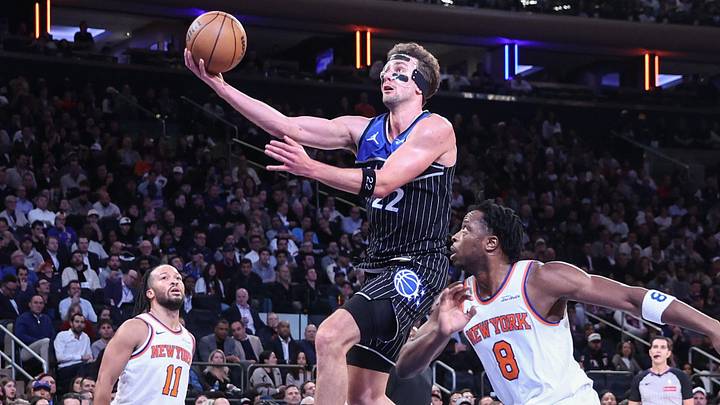
The Orlando Magic are spending their offseason trying to figure out why their season went so wrong.
They have a few working theories for sure. And they could see the team's weaknesses play out in their seven-game series loss to the Detroit Pistons.
But they could also see in that series how good they could be. Taking a 3-1 series lead before Franz Wagner exited the series with a strained calf suggested how good the Magic could be.
As president of basketball operations has spoken publicly about how to assess the season, he has gone back to that moment when the team was rolling and seemed destined to get out of the first round for the first time since 2010.
In his exit interview after the playoffs and again in an interview after the Magic hired Sean Sweeney as their new coach, Jeff Weltman stressed that the team believed its starting lineup worked. He signaled that the team did not believe it needed any major changes because the team's starting lineup worked.
They just needed to be healthy.
Whether they will get the chance to be healthy next season is the question. Things can change quickly in the NBA. And Orlando still needs to be aggressive to improve its roster, perhaps forcing it to make a major change to the starting lineup.
But this is the big assumption that Orlando's season rests on: The team's starting lineup is among the elite lineups in the league. It just did not play enough together.
The question is whether this is the correct assumption to rest its offseason on. And whether the Magic can afford to bet on that assumption.
The Magic's starting lineup
If the Orlando Magic want to argue that their starting lineup needed more time to incubate and play and that injuries were the biggest factor in the team's frustrating season, they have an argument.
Orlando's starting lineup of Jalen Suggs, Desmond Bane, Franz Wagner, Paolo Banchero and Wendell Carter had a +11.6 net rating in 182 minutes and 19 games together this season. It was the ninth-best lineup in the league to play at least 150 minutes together last season.
Only the Denver Nuggets' starting lineup and the Oklahoma City Thunder's lineup with Cason Wallace playing for Jalen Williams were better in the regular season.
The Magic's starting group posted a 117.3 offensive rating and a 105.2 defensive rating, the seventh-best defensive lineup that played at least 150 minutes. That would rank ninth in the league in offensive rating and first in defensive rating if that were their rating for the whole game.
Before Franz Wagner's injury in December, the Magic had a +14.0 net rating with a 120.1 offensive rating and 106.1 defensive rating. That is the sign of a team that was winning its minutes handily. There is something in that starting lineup.
Even in the Playoffs, the Magic's main starting five posted a +14.7 net rating with a 115.5 offensive rating and 100.8 defensive rating. That is the fourth-best lineup that played at least 50 minutes in the Playoffs, trailing three San Antonio Spurs lineups.
The Detroit Pistons had one of the best starting lineups in the league in the regular season (+11.4 net rating with a 121.4/109.9 split, the third-best net rating among lineups that played at least 150 minutes). Through the first four games of their playoff series, they had a -0.2 net rating (110.3/110.4). The Magic shut down the best lineup in the league to take their 3-1 series lead.
The Magic's starters won in the Playoffs. And that is what really matters.
But it was not just the Playoffs.
The question is whether the Magic can do that against other elite teams. And there just is not enough data from last season to conclude that.
In 12 minutes across two games, the Orlando Magic outscored the New York Knicks 30-27. Of course, both of those games were cut short due to injury -- Paolo Banchero's strained groin in November and Franz Wagner's high ankle sprain in December. And all of those games happened before the 2026 calendar year.
The Magic never had their full complement when they faced the San Antonio Spurs, Oklahoma City Thunder or Cleveland Cavaliers.
That is at least a fair argument that the Magic should wait for a healthy Wagner to see their lineup closer to full strength. Even if the bigger argument is that the Magic need a boost to better injury-proof their roster.
But they do not actually know how this team will play against elite competition. There just is not enough data with how much time Wagner missed last year.
The Magic as a top-heavy team
The biggest consideration the Orlando Magic have this offseason is rebuilding their bench. And that part is difficult because of the cap restrictions the team faced.
The Magic must believe their starting lineup is good enough to win critical games in the regular season and postseason, given how severely their bench struggled last year. And improving that bench this year will be a difficult task.
Orlando is a top-heavy team in a league that increasingly penalizes the teams that commit too much money to their starting lineup. The Magic have few options to attack their bench and improve their depth without jostling their starting lineup.
And the Magic need to be prepared to do that.
But the Magic are entering this offseason with the assumption that they have an elite starting lineup. If they can shuffle the deck on the bench, make a key signing, get growth from key young players like Tristan da Silva and get better injury luck, the team could achieve their goals.
That is a lot of "ifs" as there are in every season. And the Magic should be hunting for some certainty.
That might be the underpinning of this assumption. The one thing Orlando seems sure about is they have a strong starting five.
And, as Jeff Weltman likes to say, the Playoffs are ultimately about your best five against the other team's best five. And that might be some proof the Magic have enough to win in the spring.
 Add us as a preferred source on Google