

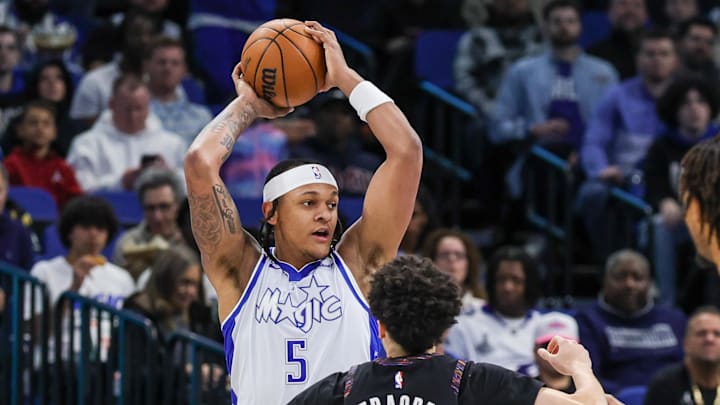
Orlando Magic president of basketball operations Jeff Weltman has been warning about this day for several years. As the team swam in loads of cap room, which it did not always know what to do with, they knew the clock was ticking.
Every team faces critical contract decisions and pressure points in its development. That is part of the new CBA system the league implemented. Teams cannot just keep adding salary anymore without dealing with the consequences.
Those consequences are coming for the Magic beginning this summer.
Extensions for Franz Wagner and Jalen Suggs have already hit. Paolo Banchero's max extension begins next season. Desmond Bane was acquired because he had four years remaining on his contract in addition to his skills.
Barring a trade this offseason, Orlando will be one of only a few teams in the league with four players making $30 million or more next season (Suggs' contract is front-loaded and will dip under $30 million in the 2028 season).
If there is urgency to contend, it is because the team is so much more expensive and it is unclear how long the franchise will keep the payroll at these levels.
It is also the reason why it might be so difficult to make the kinds of moves that dramatically launch the team forward. It is going to be an offseason of small moves. Especially if the team is so hesitant to change its starting lineup.
There is a lot to do and only a narrow path to walk to do it. The Magic are likely hoping health is their biggest step forward, even if the team desperately needs more shooting and improved depth.
So, where do the Magic stand, and what resources are ahead for them? This is the introduction to the Magic's offseason.
The Magic are a tax team now
If the Orlando Magic are going to continue to pursue a championship with this core, there is no avoiding that they are a tax team for the foreseeable future.
That limits what the team can do.
Without cap space, the Magic cannot sign any of the big-name free agents or take in more than 10 percent of outgoing salary in any trade. Essentially, Orlando cannot do anything that increases its payroll beyond re-signing its own players.
The Magic's top four players -- Paolo Banchero, Franz Wagner, Desmond Bane and Jalen Suggs -- are slated to make a combined $154.9 million. The salary cap for the 2027 season is expected to be $166 million.
And that is just for four players.
Without any changes to the roster, the Magic have $207.9 million in guaranteed salary. That includes the $8 million guaranteed to Jonathan Isaac but not the remaining $6.5 million that becomes guaranteed if he remains on the roster past June 28. It does not include the team option for Jamal Cain.
It also does not include Jett Howard and Moe Wagner, who are free agents this offseason. Those are the two open roster spots the Magic will be aiming to replace or re-sign.
The tax threshold is $201.7 million. The first apron threshold is $210.7 million. So the Magic are just beneath the first apron, but too close to the first apron to take full advantage of what is available to them at that level -- namely the taxpayer MLE.
That will limit their summer.
The Magic only have the partial MLE
If you are hoping the Orlando Magic can add someone valuable to the team in free agency, you will be out of luck.
The Magic are over the cap, so they can only use exceptions to sign new players. And those are further limited by their position above the cap.
Because the Orlando Magic are only an estimated $9 million beneath the first apron, they would only have that amount of the non-taxpayer MLE to spend. They would eat into that by picking up the option for Jamal Cain and drafting any player in this year's draft.
The non-taxpayer MLE hard caps a team at the first apron. That was one of the restrictions the team put on itself by signing Tyus Jones last summer.
The Magic were bumping up against the first apron and that hard cap this season. Dealing Jones got them under the tax and avoided starting their repeater clock -- there are escalated tax rates for teams that are above the tax for three out of four years.
More likely, the only free agency money the Magic have to spend is the taxpayer MLE, contracts amounting to an estimated $6.1 million.
If the Magic use that, they would be hard-capped at the second apron of $223.7 million. That should not be a concern. But Orlando does not want to dive too deep into the aprons sooner than it has to.
But this should paint the picture of how limited the Magic's resources are this offseason. If Orlando wants to improve the roster, it must come through trades and re-arranging the salaries on the roster already.
That is the future ahead.
The one thing looming
One other element to this offseason is looming over the proceedings.
The Orlando Magic may not want to spend too much money in free agents or adding players because of the impending extension for Anthony Black, which is expected to add another $20 million salary to their books (Black is slated to make $10.1 million in the final year of his rookie deal).
Even if the Magic do not sign him this summer and wait for restricted free agency next summer, he is expected to get quite the salary increase.
Orlando will likely avoid the second apron and all of the intense restrictions that come with it -- essentially only being able to sign minimum contracts and no trades that increase payroll -- this year. But there is no avoiding it next year if the Magic keep Black.
It is almost certain that will be the case.
That time to make major payments has come. The Magic are knee deep into it. There is no avoiding it now.
And that will be a big part of how the Magic aim to improve this offseason. There is some tricky accounting and key decisions to be made to take the next steps.
A previous version of this article stated the Magic as the only team with four players making more than $30 million. The New York Knicks will also meet this mark.
 Add us as a preferred source on Google