

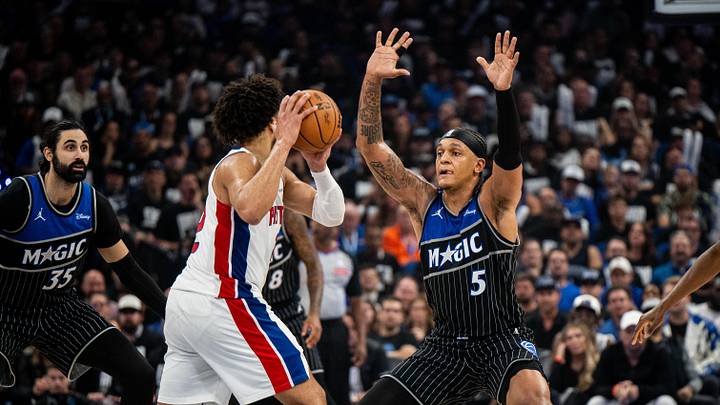
It has been a month since the Orlando Magic's season ended in Game 7 in Detroit.
Paolo Banchero exited the arena issuing what felt like a challenge to the team, his teammates and himself not to be satisfied with just getting to a Game 7 again.
Because ultimately, two of the three playoff series they have played together have ended the same way: Bitter disappointment and the feeling that they left something on the table.
The Magic, as an organization, began that change. They fired Jamahl Mosley and hired Sean Sweeney to get a new voice and some new ideas into the locker room.
There will surely be more adjustments and tweaks to the roster to come -- even if the Magic believe they do not need to make major changes.
But it is inevitable that the stink of their shocking Game 6 loss still lingers in the air. It is a question they will have to answer.
How does a team lose a 24-point second-half lead in an elimination game at home? How does a team miss 23 consecutive shots and go 45 minutes of real time without a field goal? How does a team score just 19 points in the second half of a critical playoff game?
That is a question that will hang over everyone with the Magic organization. It is impossible to move forward without recognizing it.
It was something Jamahl Mosley had to answer as he spoke with Joe Dumars about the New Orleans Pelicans opening. Just as it is something the Magic will need to answer.
"It’s easy for everybody to say, ‘Hey, we missed a bunch of shots.’ That’s true, but there’s a process that leads to each of those shots," Mosley told William Guillory of The Athletic. "It was great to walk it backwards, because it then told you about the demeanor of our guys. What was happening in those moments when you’re down?"
Mosley at least has the benefit of a new team and new toys to try to solve the weaknesses that ultimately ended his time in Orlando.
Like therapy for PTSD, the Magic, too, need to relive this moment, understand it and lessen its grip. That is the only way to move forward.
What changed in the second half
The contrast between the Orlando Magic's first half in Game 6 -- 60 points, 56.1 percent shooting, 7 for 18 shooting from three (38.9 percent) and the second half -- 19 points, 10.8 percent shooting, 2 for 18 (11.1 percent) from three -- is still pretty stark.
The Magic showed what they can be when they are firing on all cylinders and all the inconsistency that defined so much of their season.
It was not necessarily for lack of effort. But the Magic had only one fast break field goal attempt and went 2 for 15 in the paint.
Their defense mostly held up. Detroit shot 16 for 40 in the second half. But Cade Cunningham had 24 points on 7-for-14 shooting and 9-for-10 from the foul line. The 31 fourth-quarter points was a team going downhill against a team stuck in the mud -- Orlando scored just eight points in the final frame.
In the end, you need your best players to step up. Paolo Banchero and Desmond Bane combined for nine points on 2-for-20 shooting in the second half. The Magic were 9 for 12 from the line with Banchero taking six of those free throws.
Jamahl Mosley still seems to want to put a rosier picture on what happened. He said even after the game that it came down to the team just missing shots.
Indeed, Orlando shot 6 for 19 on wide-open shots and 4 for 17 from three in Game 6. The Magic were 3 for 9 and 2 for 8 from three in the second half on those shots.
Orlando might have had some unusual shot-making in the first half, but the team did not do anything worse in the second half. The team just missed shots.
And that leads to a bigger question: Was this just a crisis of confidence and a team crumbling under the closeout pressure? At the time, it even felt like a team watching a car accident occurring.
More than just the numbers
If there was something tactically wrong with the way the Orlando Magic attacked when things went wrong in Game 6, they solved that by firing Jamahl Mosley. That seemed inevitable for much of the season.
It was clear that there was more than a tactical element to that game. And that is the next part the Magic must solve.
The Magic have a mental hurdle to overcome.
It is the same mental hurdle the team needed to overcome after losing a 17-point lead in Game 7 against the Cleveland Cavaliers in 2024 or Franz Wagner's infamous 1-for-15 showing in that game. It lingered over the entire offseason until Wagner could prove he could step up in a big game -- which he did in the 2024 Olympics in Germany's fourth-place finish in that tournament.
Wagner redeemed himself in the 2025 Playoffs series with the Boston Celtics. Just as he became a vital piece to the Magic's chances in the 2026 series with the Detroit Pistons. His absence made it clear how valuable he is to making this an elite team.
But this is a new hurdle nevertheless.
Those doubts will linger. How will the Magic react against an elite team for the first time in the regular season? What will they do when they have the chance to close a team out in the Playoffs next time? Will there even be a next time?
The Magic not only have to look honestly at their roster and answer the questions about why this embarrassing defeat happened. They will also need to look at the players they want to retain and ask whether they will be ready to face this challenge again.
The Magic will have to answer these questions until they get their chance to accomplish what they failed to do on that May evening.
Game 6 was a defining moment for this team, whether they like it or not. And how they respond and correct those mistakes is the driving question for this offseason.
 Add us as a preferred source on Google