

The NBA Draft is quickly approaching on June 23 and 24.
Teams are quietly, but busily, preparing for the two-night event and setting up their draft boards for the big day. Everyone anticipates that the Draft will have some more activity than usual as teams begin their offseason. Deadlines create traction in trade negotiations.
But until those trades become official, everyone must assume the draft will go on as planned.
With the Orlando Magic deep into the tax and flirting with the first apron, their ability to draft well is essential now. The team must supplement its roster with talent and players who can contribute quickly.
Any look at the Magic's depth chart shows they still need to find some point guard help and depth. The team is also incredibly short on wings and even lacking some size.
The Magic's trade decisions and free agency will fill some of these needs. With just one pick -- at No. 46, at that -- the Magic do not have a lot of options. They are likely looking at a role player with their second-round pick, if they stay there.
The Magic need to focus on specific skills. They also need to focus on players who fill a need on their roster and likely do not need tons of time to develop and grow, since there will be so little time for them to play, given how packed the Magic's roster will be.
What do the Magic focus on? Who do the Magic focus on?
The Magic must be intentional with every roster spot. So whether the team tries to trade up into the latter part of the first round or stick with the 46th pick, the Magic have to make this right.
The Trade-Up Candidate: Chris Cenac, Jr., Houston
There are not a lot of clear-cut trade-up options for the Orlando Magic. Some of that might be a fact that it is unclear how this draft could shake out or what the Magic have to offer to move up in this Draft.
Still, the Magic should be picking a player, not picking a pick. They should be targeting the kinds of players they want.
If that is Iowa guard Bennett Stirtz, go get him (even if Jase Richardson is still on the roster).
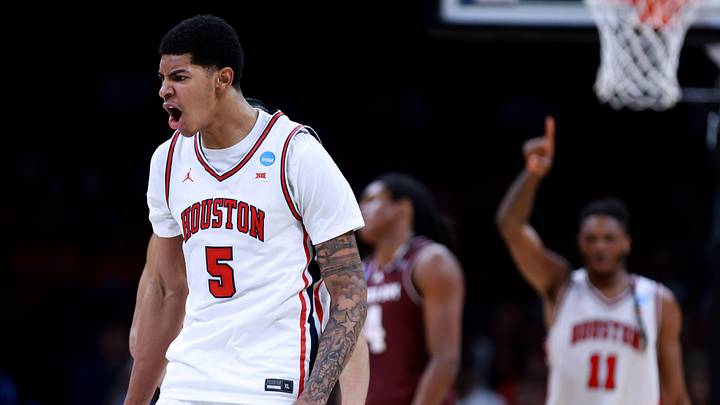
The high-upside swing I might take is Houston big man Chris Cenac Jr.
Cenac averaged only 9.5 points and 7.9 rebounds per game as a freshman at Houston. He is not much of a shooter and is limited to plays around the basket.
But his potential, especially on defense are clear. To succeed under Kelvin Sampson requires a player who knows how to defend. He averaged just 0.5 blocks per game. But Cenac's defensive presence was always clear.
Whichever NBA team selects Cenac will be betting on this incredible upside.
Cenac certainly has the look of an NBA big, measuring at 6-foot-10.25 without shoes and a 7-foot-5 wingspan. He would certainly check the boxes for the kind of size the Magic typically target.
The Big Wing: Izaiyah Nelson, USF
One of the bigger needs on the Orlando Magic's roster that I see is a surprising lack of size. Especially for a team that is stereotyped as only focusing on wingspans and size.
The Magic are kind of small everywhere. Going from Franz Wagner and Paolo Banchero at forward to Jamal Cain and Tristan da Silva off the bench left the Magic much smaller than that philosophy would suggest. Not having Jonathan Isaac available only made that lack of size more apparent.
The Magic should want players who can contribute quickly, but the best bet for players who can find a role quickly but still develop are the athletic big wings.
One name has emerged in many of the mock drafts around where the Magic are picking in USF forward Izaiyah Nelson.
Nelson averaged 15.9 points per game and an AAC-leading 9.6 rebounds per game last year after transferring from Arkansas State. He tracks more as a center or post player than a wing, that will be the biggest adjustment. He is not a shooter at all yet.
But Nelson measured at 6-foot-8.25 without shoes with a 7-foot-2.5 wingspan. Length and athleticism can make up for some skill gaps. And Nelson will be on the radar for that reason alone.
The Magic need to get bigger on their wings. Even if shooting remains a far more necessary skill to find.
The Athletic Center: Trevon Brazile, Arkansas
Athleticism can close the skill gap just by allowing players to make up for mistakes on physical attributes. If a player wants to contribute, just being able to step on the floor and make things happen on raw talent goes a long way. That is how Noah Penda made an impact.
It is why young, athletic centers tend to find a way to make impacts quickly. Just being able to block shots and be a presence around the rim goes a long way as they grow and develop.
That is one of the attributes that the team will be looking to find. And if the move is to trade Goga Bitadze, the Magic will need a center to replace him.
Trying to target four-year Arkansas big man Trevon Brazile makes sense then.
Brazile averaged 13.0 points per game and 7.3 rebounds per game last year. He added some 3-point shooting too, making 34.1 percent of his 3.7 attempts per game. That could be another element to add. He also blocked 1.6 shots per game.
He measured well, too, coming in at 6-foot-9.5 without shoes and a 7-foot-3.75 wingspan. Brazile moves well and can be an impactor away from the basket.
The Wing Scorer: Nick Martinelli, Northwestern
Full disclosure, I am a Northwestern alum and fan. I have watched a lot of Nick Martinelli in the last four years. I will not complain if the Magic make him the pick at No. 46. It would not shock me if he is not there when the Magic pick in two Wednesdays.
Martinelli might be the craftiest and smartest scorer in college basketball, leading the Big Ten in scoring in each of the last two years. Yes, a player from just Northwestern led the Big Ten in scoring for the past two years -- clocking in at 20.5 points and 23.0 points per game the last two seasons.
Martinelli is not overly athletic. But he is tough and knows how to use his pivot foot and dribble moves to get to his spots and score.
The Wildcats put the ball in his hands a lot, particularly after current Oklahoma City Thunder two-way forward Brooks Barnhizer graduated. So he was going to score by osmosis. But he still shot 47.1 percent and 51.0 percent from the floor in those two seasons. He does not make loads of mistakes or have poor shooting games.
The biggest concern with Martinelli is whether he can get his shot off and get to his spots against the bigger, more physical defenders in the NBA. He also likely will not be on the ball as much, making his shooting far more important.
Martinelli shot 41.7 percent from three last year but is a carer 36.2 percent from beyond the arc. He shot 80.9 percent from teh foul line and 76.5 percent from three.
The Magic need more players like Martinelli who can take the ball and find a way to score. But nobody really knows how he will function as a stricter role player.
The Point Guard Option: Ja'Kobi Gillespie, Tennessee
I am skeptical the Orlando Magic will target a point guard in this year's draft, even if it is clear that is a big need.
The Magic need to find some point guard depth. But with Jase Richardson in his second year, the Magic do not want to put another young player in front of him -- especially with Richardson on a first-round pick's contract.
But there are a fair share of guard options.
Ja'Kobi Gillespie was mocked to the Magic in the last mock draft from Christopher Kline of Fansided. It is clear to see some attraction.
Gillespie averaged 18.4 point sper game in his lone season at Tennessee (he averaged 14.7 points per game the previous season at Maryland). He added 5.4 assists per game and 2.0 steals per game.
His size works against him. He measured at 5-foot-11.75 without shoes and a 6-foot-4 wingspan, the sixth shortest at the Combine.
Gillespie plays hard and still must improve as a shooter to make it in the NBA. But he is on the radar as a decent guard option.
 Add us as a preferred source on Google