

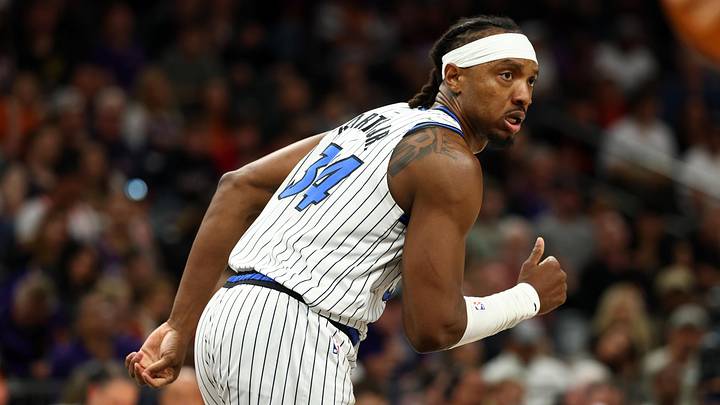
Orlando Magic president of basketball operations Jeff Weltman has warned that the team would pay the piper at some point.
The young players they had accumulated and retained would become expensive at some point. And the free ride and possibilities of maximizing cap space and flexibility would end.
The Magic's trade for Desmond Bane last summer was the last big move the team could make before it dove headfirst into the world of the league's aprons and the restrictions of being a tax team.
And the Magic are prepared to be a tax team this summer, all the while being mindful that Anthony Black is about to sign a big extension one way or the other. The Magic are dancing down a narrow line.
Weltman said on his radio interview early this week that teams still believe the Magic have quality young players. There should be a market if Orlando wants to explore the trade market.
But, as much as everyone is eager to see how this team can improve, the Magic are navigating the difficult labyrinth that is the NBA's tax aprons. Orlando not only has to find a deal that it feels improves the roster, but also one that fits under the team's rules.
Most of the trade ideas out there in the trade machine universe, and even some seemingly sensible deals, fall flat because they do not meet the criteria.
Orlando is unlikely to cut payroll or take a step back. This team should be trying to remain aggressive. But without a willingness to trade any of their starters, it would be tough to swing anything substantial.
The Magic do not need a quiet summer. But, in all likelihood, this is a summer of moves on the margins and a hope the team can stay healthy.
What are the apron rules?
If you are unfamiliar with the rules of being in the first apron, that is OK. The Orlando Magic have not been a tax-paying team since Dwight Howard's last season in 2012.
Orlando used its trade deadline to trade Tyus Jones and dip under the tax to avoid starting the repeater tax clock. There are a lot of machinations.
The important thing to remember is that the Magic are destined to be a first apron team this year.
They have an estimated $207.9 milliion in guaranteed salary for next year before considering guaranteeing Jonathan Isaac's full contract and Jamal Cain's team option. The projected salary cap for the 2027 season is expected to $165 million. The first apron is expected to be $209 million.
Guaranteeing Cain's salary would take the Magic over the first apron. As would re-signing Moe Wagner in free agency.
Essentially, the Magic will be over the first apron this year. That comes with several restrictions:
The first big one is that the team would only have access to the taxpayer mid-level exception of $6.1 million. That would hard cap the team at the second apron of $222 million. That should not be a concern -- but will become one depending on Anthony Black's extension.
The Magic would not have access to the full mid-level exception because that hard caps a team at the first apron.
There are other restrictions though that will make trades difficult.
Being in the first apron means the team cannot take back more than it sends out in a trade. Any trade the Magic make must decrease their payroll.
That immediately makes trades hard, eliminating a whole host of teams that are also under that restriction.
The Magic cannot deal with other apron teams essentially.
The Magic also cannot use their $7 million traded player exception from the Tyus Jones trade unless they are far enough beneath the first apron. Teams in the first apron cannot use traded player exceptions created in the previous year. That tool expires on June 30, when the NBA calendar flips.
It makes a tiny pathway to make trades or overcomplicates the process to making a deal happen.
Making a deal
There are some simple deals the Orlando Magic could do just based on the math of salary cap trades. Fans may even like a few of them.
Want to swap Wendell Carter ($18.1 million salary in 2027) for Daniel Gafford ($17.3 million)? That is easily done and satisfies all the conditions.
Want Orlando to get a veteran guard in Jrue Holiday ($34.8 million)? That would cost Jalen Suggs ($32.4 million) and Jase Richardson ($3.1 million) to satisfy the first apron conditions.
Want to go smaller and add a shooter like Sam Hauser ($10.8 million)? That costs Goga Bitadze ($7.6 million) and Tristan da Silva ($3.9 million).
The value of any of those deals is fair to debate. But half of the battle in completing a trade is balancing the math equation. And that equation gets only more difficult when a team is sitting in the apron and cannot take on more money than it sends out.
Improving the roster while decreasing payroll is a difficult, but not impossible task.
In all likelihood, the trade the Magic make could be some complicated three- or four-team deal. Those have become more prevalent around the league because of these apron restrictions. Nobody lets the rules stop them from getting the players they want.
Orlando will need to be creative too.
But the team also has precious little to offer at this juncture. Bitadze's $7.6 million in the 2027 calendar year will net far less than the $8.3 million 2026 salary (making a trade perhaps necessary before June 30.
Anthony Black at $10 million is undervaluing what he will eventually make with a new extension.
Orlando has a lot of contracts on the expensive end and few in the mid-tier. Carter going from $10.9 million in 2026 to $18.1 million in 2027 means the Magic can get a lot more for him by waiting. But there are no other mid-level contracts to move.
That makes things much more difficult.
It all points to the Magic one day using one of their big salaries to split into two players. Something that will become more difficult when the team is in the second apron and can no longer aggregate salaries (trade two players for one).
It is indeed a new day for the Magic. And there are a lot of restrictions that will make finding the right deal for this team possible.
 Add us as a preferred source on Google