

The Orlando Magic are surely active in their offseason as they explore ways to improve their roster.
Typically, the Magic would have a first-round pick to buoy their draft preparations. They would know they have one of the top 30 picks and the guarantee of a few years with first-round picks.
For the first time in more than a decade, the Magic will not make a first-round pick unless they trade back into the first round. They will only have the 46th pick. That is their only Draft support this year.
That can still be a valuable pick. But a mid-second-round pick is hardly expected to be an impact player. The last time a player picked 46th stuck in the league was Dalano Banton in 2021, Taylen Horton-Tucker in 2019 or De'Anthony Melton in 2018.
But Orlando is now a tax team. And that makes draft picks even more important to supplement the roster with cheap players. The Magic cannot afford to miss on their draft picks anymore -- that is how tax and apron teams fall behind quickly.
Orlando should be looking for a player with a specific skill set that translates to their team and can contribute quickly.
This is not to say the Magic will get a finished product. But the player they draft should have an immediately translatable skill. That is more difficult to find the deeper you get into the draft.
The second round is still filled with those players. And the Magic can still target a few players that fit their needs.
There are a lot of needs the Magic need to fill. And the draft is a part of the puzzle to filling them.
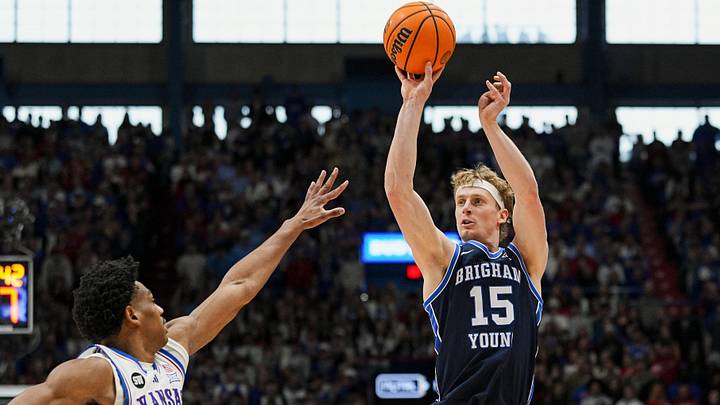
The shooter: Richie Saunders, BYU
Richie Saunders is considered one of the better shooters in this draft class after he made 37.6 percent of his 6.8 3-point attempts per game. This came a year after he shot 43.2 percent on 5.2 attempts per game.
He was the perfect complement to A.J. Dybantsa at BYU last year. The shooter and movement shooter, something the Magic are lacking, that he needed to create space.
Why is he not a first-round pick then?
That answer might be that he tore his ACL in February. So he is in the midst of his recovery from that injury.
This is where being a second-round pick and a contending team might be beneficial. The Magic could easily give him a rehab year in the G-League and bring him onto the main roster full-time next year. They can be patient for a skill they desperately need.
It is a fair question whether the Magic would want that kind of player when they need to be economical with every roster spot. But the Magic are also not in a situation to give up on a shooter of this caliber.
The scorer: Otega Oweh, Kentucky
One of the Orlando Magic's biggest needs is to find players who are unafraid to score the ball and attack off the dribble. They need more players who are comfortable with the ball in their hands.
That is an exceedingly difficult skill to find in the second round. If there were skilled scorers who could fit into a team scheme, they would likely be taken much earlier.
Otega Oweh of Kentucky had a breakout season last year averaging 18.6 points per game. He increased his scoring average in each of his four seasons in college with Kentucky and Oklahoma, averaging 16.2 points per game in his first season with Kentucky.
He was the pick in Christopher Kline of Fansided's full mock draft at 46.
The big issue with Oweh is his inconsistent 3-point shooting. He is a career 34.7 percent shooter but made only 33.3 percent of his outside shots last year.
Oweh will be on the ball a lot less in the pros. Finding that defining skill is vital to his ability to get drafted.
The point guard: Braden Smith, Purdue
The Orlando Magic are still in a bit of flux at point guard.
The team clearly benefits from a true point guard who can manage the game and organize the team. That is why Markelle Fultz, Cory Joseph and Jevon Carter provided such a big boost in the last three years, despite their clear flaws.
The Draft is probably not the place for the Magic to hunt for their point guard. They probably would prefer a veteran to fill that spot. Someone they know can be a steady hand.
The reality might be that the Magic could fall into one of the most prolific game managers and passers in the college game.
Purdue guard Braden Smith was a two-time consensus All-American and set the NCAA record for assists in a career. He averaged 8.8 assists per game after averaging a nation-leading 8.7 and 7.5 in the two previous seasons.
Smith is a great passer and can get to his spots in the mid-range and hit shots. He averaged 14.3 points per game and shot 44.0 percent from the floor.
Smith still must develop as a 3-point shooter. He made 38.5 percent for his career and 36.2 percent last year. He was a career 83.2 percent free throw shooter.
The shooting remains the biggest question mark and the difference between him being a solid NBA player or merely a college star. His lack of size is his biggest demerit too -- measuring at 5-foot-10.25 without shoes and a 6-foot-3.25 wingspan.
The big: Nate Bittle, Oregon
The center position is going under a transformation with Victor Wembanyama taking over.
Teams still need size to deter players from getting to the rim. But the league cannot stomach stiff centers who cannot hold their own a bit on defense and make plays on the ball. The league does not like stiffs anymore.
Bittle has the size, listed at 7-feet and 215 pounds. He put in solid numbers with 16.8 points per game. He averaged 1.8 blocks per game and was at 2.1 per game in the 2025 season at Oregon.
Bittle could be the rim protector that a team later in the Draft is looking for.
The real question is whether his 3-point shooting and passing can develop. Because that is the ticket for bigger centers. They have to bring some skills to the table.
Bittle shot 31.9 percent on 4.5 3-point attempts per game. That is at least a willingness to step outside and space from three. He shot 73.2 percent from the line (73.6 percent in his four-year career). That continues to suggest there is room for him to keep growing as a shooter.
But that is where a lot of his hope will lie. He is a drop big. And it is hard to be a drop big in this league and be more than a bench player.
The project: Tobi Lawal, Virginia Tech
The Orlando Magic do not need a player who is an extreme project. They need someone who can contribute something immediately to the team. They have a project already in Noah Penda.
But, in the end, the Magic need talent too. And young talent you believe in is almost always worht waiting for.
That is why a player like Virginia Tech forward Tobi Lawal is worth looking at.
He averaged only 12.3 points and 8.5 rebounds per game last year. But he added 1.1 blocks per game. He also ranked first in standing and max vertical leap at the NBA Draft Combine at 40 and 45.5 inches. Lawal measured at 6-foot-7.25 without shoes with a 6-foot-10.5 wingspan.
He has the measurables the Magic typically look for.
Orlando is looking for strong defenders and Lawal has the tools to be an excellent defender. The Magic also need some more athleticism and above-the-rim play. That is something Lawal can provide too.
That keeps him on the radar.
 Add us as a preferred source on Google