

How were the Orlando Magic going to answer this one?
A potential overtime loss after leading by 18? Another lifeless fourth quarter offensively and another lead that quickly fell apart? Another game where the Magic showed their potential and came up just short?
Those are all fair questions. Orlando has struggled to meet its standard and look like the championship team it aspires to be.
But it is so much better to ask those questions after a win. It is so much better to know the team has players who can play the hero and bail them out.
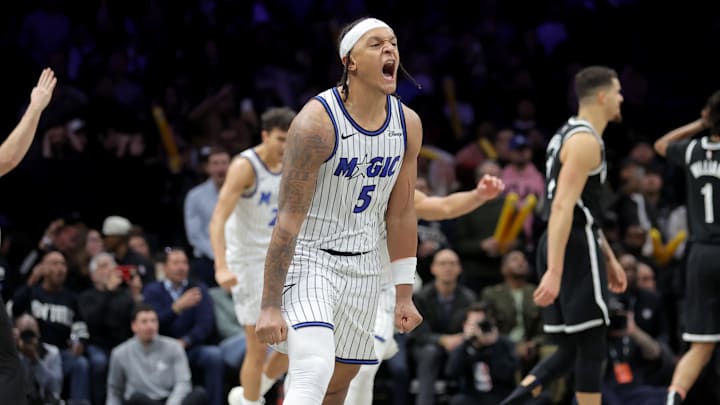
This time, it was Paolo Banchero's turn.
Banchero had the answer with a little more than two seconds left in overtime, dribbling to the top of the key and banking in a three to deliver the Magic a 104-103 overtime victory over the Nets. That is a measure of relief because wins are wins, and they all count the same.
"It's always good to win," Banchero said after Wednesday's win. "I think that's the main thing is getting a W. It made the game a little closer than we would like. But getting the W is what matters."
But those questions still do not go away.
Orlando is playing to a standard, after all, and has those championship ambitions. The Magic have bailed themselves out plenty this year -- getting that game-winning three after a late fourth-quarter collapse against the Portland Trail Blazers; storming back to defeat the Brooklyn Nets earlier in the year, and winning on a 9-0 Franz Wagner run; and getting a game-winning layup after a fourth-quarter collapse against the Utah Jazz.
It begs the question: Why do they need to do this so often?
Fourth quarter struggles, fourth quarter heroics
This story is not new for the Magic.
They have had heroic games before but they have all followed the same script. Orlando had a lead in the second half only to see the fourth quarter become their undoing.
It is a good thing that Orlando has several options to hit the game-winning shot. That will be important in the Playoffs.
But many of those shots came because the Magic could not put teams away. That is the concerning part.
Desmond Bane's game-winning shot against the Portland Trail Blazers came only after the Orlando Magic lost a nine-point lead with 2:32 to play.
The same thing happened in Bane's game-winner against the Utah Jazz. Orlando had an eight-point lead with 3:49 to play in regulation and a four-point lead with a minute to play in regulation before the Jazz tied it up.
That does not speak to the losses that came in the fourth quarter either.
The Orlando Magic gave up a 15-3 run to open the fourth quarter in the loss to the Golden State Warriors, turning a close game into a runaway. They scored only 12 points in the fourth quarter of a one-point loss to the Toronto Raptors just last week, losing on a three-point attempt from Banchero at the buzzer.
This game-winner on Wednesday was redemption for that moment, but played out much the same as that disappointing defeat. The Magic were in control of the game and fell flat in the fourth quarter.
That has been the main pattern for this team. Orlando is 24th in the league with a -4.3 net rating in the fourth quarter. Their 109.8 offensive rating is 25th in the league and 114.1 defensive rating is 16th in the league.
If it feels like fourth quarters have been an uneasy exercise all season, there is good reason. It has been. They are critical lessons the team needs and needs to improve as the season progresses.
"It just keeps creating the resiliency that we know this group has," coach Jamahl Mosley said after Wednesday's win. "It's building for the future and what we're going to go through. Any time you can learn the lessons in a win."
The Magic are struggling to finish games. Only these heroic shots have saved them.
How the Magic collapse
That does not make it any less shocking that the Orlando Magic collapsed in the fourth quarter, even against a quality defensive team like the Brooklyn Nets.
It felt like the Magic would cruise to a victory after taking as much as an 18-point lead and leading by 15 points entering the fourth quarter. Orlando's defense was on point and the team was able to get enough help around Paolo Banchero and his aggressive attacks to the basket to make things work.
Two things happened to lead to this specific collapse.
The first is that Brooklyn started to make its threes. The Nets ended the game 17 for 51 (33.3 percent) from three and began to overwhelm the Magic with volume. They were 5 for 10 in the fourth quarter -- and made both threes in the final three minutes to complete the comeback.
Orlando had no answer because the offense went into the tank. Things slowed down, and the team relied too heavily on Banchero trying to create at the top of the key. The team's ball movement slowed to a crawl.
The Nets deserve credit for this. They employed a trapping defense to try to force the ball out of Banchero's hands. While Orlando was excellent attacking this defense through three quarters, things slowed down in the fourth and the Magic could not get quality shots or make the ones they got. The Nets got the Magic out of their comfort zone.
"Hitting big-time shots. We have to give them credit for the fight they put in," Noah Penda said after Wednesday's win. "Just an amazing amount of talent they have on their team. It's something that amazes me after all these games. They were just battling to the end. It was about who wanted it more."
Still, Orlando led by eight with three minutes to go. It would have taken only one shot to calm the team down. Avoiding a few fouls, grabbing a key rebound -- particularly the one at the end that set up Egor Demin's game-tying three -- could have flipped the game back in their favor.
At every turn, Orlando failed to make the play to turn the tide back in its favor.
Instead, the team fell back into bad habits offensively. Not even Banchero, who had 30 points in the game, could rescue them.
It is just a continuation of a major problem the Magic have had all year.
Yes, Banchero was the hero and ultimately won the game. That is what matters. But fourth quarters have become a major problem for this team.
 Add us as a preferred source on Google