

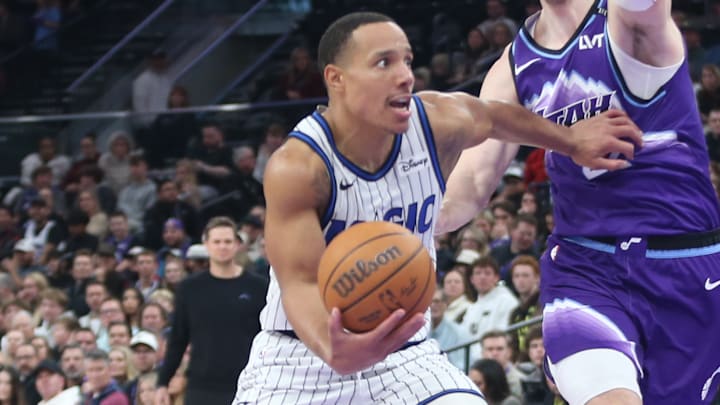
The game and survival came down to one play for the Orlando Magic against the Utah Jazz on Saturday.
Anthony Black, after initially playing good defense, fouled Keyonte George as he drained a three-pointer to tie the game. Orlando had already lost a 17-point fourth-quarter lead to get to overtime. The team now found itself down by one with five seconds to play.
Orlando needed a play. The team needed to get back to what works for this team. The team needed some movement to regain its energy.
Magic assistant coach Joe Prunty drew up the play in the huddle after the timeout. The Magic inbounded the ball to Wendell Carter at the foul line. He turned to hand the ball off to Desmond Bane, running straight downhill after the inbounds.
Desmond Bane used that momentum to get past Svi Mikhailiuk and to the basket and hit a tough layup over Kevin Love to give Orlando the lead again. The Magic were able to run the clock out with Anthony Black first deflecting a lob attempt out of bounds and Wendell Carter deflecting the last attempt to win.
Orlando escaped Salt Lake City with a 128-127 overtime win.
"Joe [Prunty] drew up a good play," Bane said after Saturday's game. "A lot of action leading to Dell getting a good catch, allowing me to get downhill and touch the paint. He's telling me to put pressure on the rim. I saw a crease and made it happen."
It was the movement and motion that mattered. After spending the better part of two quarters stuck in the mud with little offensive life, the Magic suddenly had a burst of energy.
They found it when the game was on the line after squandering a 16-point lead with 6:45 to play.
It was only through movement the team actually won the game in the end.
The Magic's new philosophy
From the opening of training camp, the Orlando Magic proclaimed they were turning a new leaf on offense. They were not going to be stuck in the mud again and saddled with the lowest-possession offense in the league.
Orlando intended to pick up its pace. The team wanted to use its vaunted defense to create offense. The Magic wanted the same energy it has on defense to feed into its offense.
That plan has largely worked.
Orlando was 27th in offensive rating last year and near the bottom of the league in fast break points and even transition possessions. This year, the team is 10th in the league in offensive rating at 115.6 points per 100 possessions and second in the league in fast break points with 18.6 points per game.
Orlando has found a way to build an offense, even with still-inconsistent shooting, through this pace and energy. At its best, the Magic's offense moves up the floor quickly and whips the ball inside, out and around the horn with quick decision-making and constant movement.
That is what the Magic were supposed to fix right?
In the middle two quarters, the Magic outscored the Jazz 61-44 to build their lead up to as much as 19 points. Orlando shot 53.5 percent and made 7 of 20 from three (the team made 11 total for the game). The Magic posted a 122.0 offensive rating.
Paolo Banchero had just nine points on 2-for-6 shooting, but he had six rebounds and eight assists. Those eight assists were a sign of how much he was making an impact and how he was readingthe defense quickly to keep the ball moving to find the open man.
More than that, the Magic stymied the Jazz, keeping them from getting out in transition. Orlando's defense created its offense, exactly how it is meant to.
The Magic met their ideal and seemed poised to coast to victory.
Fourth quarter, bad habits
What happened then in the fourth quarter? How did the Orlando Magic offense crater to give up a 16-point lead in the final 6.5 minutes? How did Orlando fall back into bad habits?
The Utah Jazz outscored the Orlando Magic 36-21 in the final quarter, finishing the game on a 24-8 run to send the game to overtime.
The Magic shot only 7 for 20 from the floor with Banchero failing to record an assist and missing all four of his shots -- he missed his last 11 shots overall to finish with 23 points, nine rebounds and nine assists.
Quite simply, the Magic's offense stalled out because they stopped moving. The ball stagnated and the team seemed to be trying to force the ball to Paolo Banchero or to favorable matchups rather than moving and cutting. The defense could load up on wherever the ball was supposed to go.
Orlando's pace went from 99.0 possessions per 48 minutes in the middle two quarters -- slow for the team, but a pace the team could control against a fast-paced Utah team -- to 92.0 possessions per 48 minutes in the fourth quarter.
The team suddenly just moved too slowly. It was a struggle to get the offense going and the Magic were not getting stops to feed the fast break.
Orlando had to find a way to get the job done, but the team squandered its cushion.
"Keep our poise. Keep our head. Find a way to go back out and get the job done," coach Jamahl Mosley said after Saturday's win. "That's what these guys had to make sure they continue to do. Regardless of what happened in that game, you have got to continue to find a way to put the game away. "
That is typically what happens when Orlando's offense hits these ruts. Everyone is moving too slowly and the ball is not moving from one read to the next.
The Magic still have these moments where they struggle to create good looks and struggle to hit the shots near the rim. They still have moments where they expect the officials to bail them out with calls.
They still sometimes look like the team that struggled so much last year.
Orlando's offense is significantly improved. The team has the players and weapons now to be one of the best offenses in the league.
But these bad habits and familiar struggles still occur. And are occurring far more often recently.
To keep their offensive revival, they need to keep their offense's energy up.
The Magic were able to find their energy and motion late in overtime. They were able to do enough to win the game.
 Add us as a preferred source on Google