

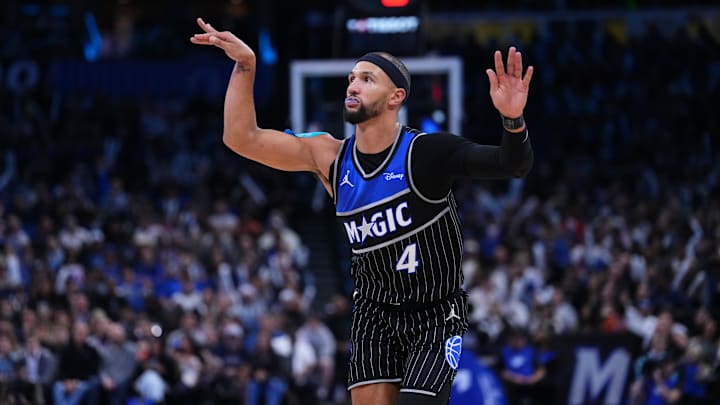
The Orlando Magic have a lot of confidence in their offense.
Even on a night when things were not working particularly well Wednesday against the San Antonio Spurs, everyone felt the team was one spark away from turning the game around.
The mad dash to end the game nearly flipped the entire script and delivered Orlando a late win.
The Magic scored 27 points in the final four minutes of the game and made both of their three-pointers. The team's offense switched on in an instant. And Orlando tied the game with seven seconds left, only losing on a foul on defense and a blocked shot at the rim at the buzzer.
The turnaround spoke to how powerful this Magic offense can be. But the struggles beforehand still hint at one of the biggest issues facing the team.
Orlando's offense is greatly improved, but the team is still lagging in that same key area that has seemingly always slowed this team down: its shooting.
The Magic's game against the Spurs on Wednesday ended with a 104.7 offensive rating, the third-worst offensive showing of the season. It shows that this year, even when the Magic are struggling on offense, they are still a potent and dangerous team.
Orlando is still ninth in the league in offensive rating at 116.7 points per 100 possessions. The team is still capable of scoring -- and Paolo Banchero is set to return Friday after being upgraded to QUESTIONABLE on the team's injury report, according to Jason Beed of The Orlando Sentinel.
But shooting could still be the thing that derails the team this season. It is a problem that continues to vex the team.
The Magic's new shooting problem
Nobody really expected the Orlando Magic to become an elite offensive team. The Magic hanging out in the top 10 in offensive rating a quarter of the way through the season is a moderate surprise.
It is a big surprise especially because the team is still not shooting well.
The Magic rank 24th in the league in 3-point field goal percentage at 34.3 percent and 19th in effective field goal percentage at 54.0 percent. Orlando is not wholly reliant on 3-point shooting, taking 32.5 attempts per game, good for 26th in the league.
Desmond Bane is shooting a career-worst 33.3 percent from three this season and taking only 4.9 3-point attempts per game the fewest since his rookie year.
Tyus Jones, signed to help support the team's shooting too, has made only 8 of his 34 3-point attempts (23.5 percent).
There are good 3-point shooting jumps from Wendell Carter (42.4 percent, even after an 0-for-4 showing on Wednesday), Franz Wagner (34.4 percent), Tristan da Silva (38.6 percent) and Anthony Black (33.8 percent).
The last three games have bene more reminiscent of last year's frustrating shooting performance, going 23 for 90 (25.6 percent) in that span.
There is clear room for improvement. The Magic's shooting will likely still be inconsistent and have its ebbs and flows.
But the team's shooting problems go deeper. It is a trend that analysts like Kirk Goldsberry of The Ringer has been watching for a time. Orlando is simply not taking a ton of jumpers.
The Magic are 29th in the league with just 41.5 jump shots per game, according to data from Synergy Sports. Only the Detroit Pistons take fewer.
The Orlando Magic are 29th with 0.950 points per possession on jump shots, ahead of only the woeful Indiana Pacers. The team is also 29th making only 34.1 percnt of its jumpers, ahead of only the Portland Trail Blazers.
It is a consistent issue: The team takes few jumpers and makes few jumpers.
Shooting is still not part of the scoring formula.
How the Magic score
The Orlando Magic obviously can still score.
The jump shooting problem may not become a real issue until the Playoffs when teams can lock in on the team's preferences.
It is hanging in the background though. And Wednesday's loss showed how the Magic's poor jump shooting can cost them when those other elements do not work completely in sync.
Orlando has three main methods to score.
The first is how they pummel the paint. The Magic are third in the league with 55.0 points in the paint per game. They are sixth in the league with 29.5 field goal attempts per game in the restricted area, according to NBA.com's tracking stats.
Orlando's whole purpose is to get downhill and to the rim any way the team can.
That was something the Orlando Magic did well Wednesday, outscoring the San Antonio Spurs 64-42 in the paint.
But the Magic shot only 32 for 65 in the paint. Those were missed opportunities that hurt them.
All that pressure on the rim typically means the Magic get to the line a lot. Orlando is second in the league with a 34.4 free throw rate (they take 34.4 free throws for every 100 field goal attempts). The team leads the league with 30.2 free throw attempts per game.
Orlando has had some poor free throw shooting games -- including six misses Wednesday. But the team ranks ninth in the league at 80.5 percent shooting from the foul line.
The problem Wednesday was the Magic could not get to the line, perhaps accounting for many of their misses. They shot a season-low 19 free throw attempts in Wednesday's loss. Losing that steady stream of points and pace control cost them.
Orlando has also turned into one of the best transition teams in the league. The Magic are sixth in the league with 23.8 transition possessions per game and fourth in the league with 1.214 points per possession. That is a marked improvement from last season.
Wednesday, the Magic still got 21 fast break points per game, marking the 12th game with at least 20 fast break points this season after they had 12 all of last year.
But again, the Magic made only 8 of 18 attempts.
With the three pillars of the Magic's offense struggling to take full advantage of this team's prowess, the jump shooting problems became more apparent. Orlando is still trying to have shooting as a backstop and another way the team can win.
Orlando's offense has indeed come a long way. But there is still that same familiar skill holding the team back, even if just a little.
 Add us as a preferred source on Google