

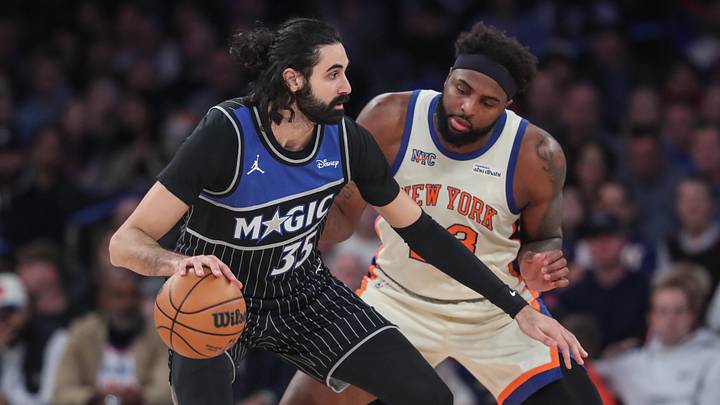
Orlando Magic president of basketball operations Jeff Weltman has been previewing the restrictions the Magic are facing for a few years now.
Even when the team had a lot of money he would note that the salary cap comes for everybody. The free spending the Magic undertook in the early part of the rebuild would run out. Weltman could see the runway ending.
That time is now after the team extended all four of its core players and acquired Desmond Bane in last year's massive trade.
If it feels like the Magic are hitting a dead end with their inability to make moves this offseason, that is the point.
The owners wanted to create a hard cap without creating a hard cap. The apron rules are serving as a ceiling that most owners are refusing to eclipse.
If anything, that should be increasing the Magic's urgency to go deeper into the Playoffs before the wave starts receding and the team has to deconstruct its roster to bring costs under control.
That was the constant theme throughout the NBA Draft. The deals made around the Draft were mostly teams trying to maneuver their way around the cap and set up their free agency. It was mostly teams trying to cut costs -- indeed, the Magic moving back from 46 to 51 to draft Izaiyah Nelson could partially be financial.
The way the Cleveland Cavaliers, New York Knicks and Denver Nuggets acted on Draft day is merely a preview of what is in store for the Orlando Magic's future.
Ducking the apron
All three of those teams -- the Cleveland Cavaliers, New York Knicks and Denver Nuggets -- are trying to compete next year. They are not in player-cutting mode.
But they did backflips to avoid the first round of the Draft. They did not want to commit salary if they did not have to.
The Cavs just acquired James Harden at the trade deadline to boost their lineup, helping them reach the Eastern Conference Finals. The Knicks just won the championship, but have made it publicly known they do not want to be in the second apron. The Nuggets are playing out Nikola Jokic's prime and want to remain competitive as they make tough calls elsewhere on the roster.
All three teams traded out of the first round for the smaller salary scale and non-guaranteed deals in the second round. Whatever money they could save, they took.
The Knicks are currently projected to be $3.5 million under the first apron, according to Spotrac, but have Mitchell Robinson, Landry Shamet and Jose Alvarado's free agency to deal with. That will likely make them approach the second apron.
Trading the 24th pick to the Los Angeles Lakers, and then trading the 25th pick to the Dallas Mavericks, and then trading the 30th pick to the Phoenix Suns was all about avoiding the guaranteed salary of the first-round rookie scale. The New York Knicks moved down further in the second round, trading the 31st pick to the Houston Rockets.
They still ended the night with Germany's Jack Kayil and Vanderbilt's Tyler Nickel as second-round picks. But those are considerably cheaper than paying first-round picks.
The Cavaliers are one of the few teams over the second apron, sitting $210k over that mark. They traded out of the first round, swapping with Sacramento to take Maleek Anderson in the second round.
Similarly, the Denver Nuggets traded down from their first-round pick to take Arkansas' Trevon Brazile in the second round. Denver is $2.6 million beneath the second apron.
They were not the only ones pushing to save money.
The Minnesota Timberwolves were only $220k below the first apron last year. Their salary dump of Julius Randle freed up the space to push in for LaMelo Ball and stay under the second apron after signing Ayo Dosunmu. But it started as a salary dump, including sending out their first-round pick to the Brooklyn Nets.
Every dollar saved matters for these teams and provides a little more flexibility as they try to get closer to a championship without sacrificing too much of their core.
The clock is ticking
The Orlando Magic are not too far away from where these teams are in assessing their roster and figuring out how to improve their team. Clearly, these teams can still maneuver with bigger salaries. But adding on the margins is more difficult.
And taking some savings in the second round still matter.
Orlando is about to feel the pressure that comes from being in the aprons and over the tax line.
The max extensions to Paolo Banchero and Franz Wagner are in full effect beginning in the 2027 season. Wendell Carter starts a new extension (the max of his type, starting at $18.1 million). Jalen Suggs is in the middle of his large extension.
And then the Magic acquired Desmond Bane last summer, giving them four players currently making $30 million for the 2027 season.
For the first time since Dwight Howard was on the roster in 2012, the Magic are expecting to be a tax team. That is a price ownership seems willing to pay.
More than that, the Magic are likely to be over the first apron with all the restrictions that come with that this season and moving forward. The Anthony Black extension could put the Magic above the second apron -- someplace that few teams venture and certainly a place no team that is not competing for a championship wants to be.
For now, Orlando seems unwilling to make a trade involving their key starters. Jeff Weltman has publicly said he has faith in his starting lineup.
But even that public statement seemed like it was an ultimatum. If this group cannot figure out how to play effectively together, then changes must come. The question is whether those will be changes to improve the roster further or a retreat back to the safety of being below the tax.
That is what a lot of the successful teams ultimately must consider. The Magic are now in that bunch.
And what Orlando saw several teams do during the Draft may well be their future.
 Add us as a preferred source on Google