

Entering the second round of the NBA Draft, Orlando Magic fans were concerned with two things.
The first was that the Magic, with so few avenues to add players to the roster with the first apron restrictions, needed to hit on the 46th pick with a rotation player. That is a stretch, looking at past players taken with that pick and that late in the Draft.
The next concern was that the Magic would punt on the second round as Jeff Weltman has done, trading seven of the 11 second-round picks he entered the Draft with in his tenure with the Magic.
In the end, the Magic are just going to draft the player with the longest wingspan anyway, right?
In that way, the Magic's draft on Wednesday went exactly to form.
Orlando seemingly drafted the rim-protecting, rim-running big man they needed in Tennessee's Felix Okpara at No. 46, only to trade him to the Washington Wizards for the 51st and 60th pick. Orlando sold the final pick in the Draft to the Milwaukee Bucks.
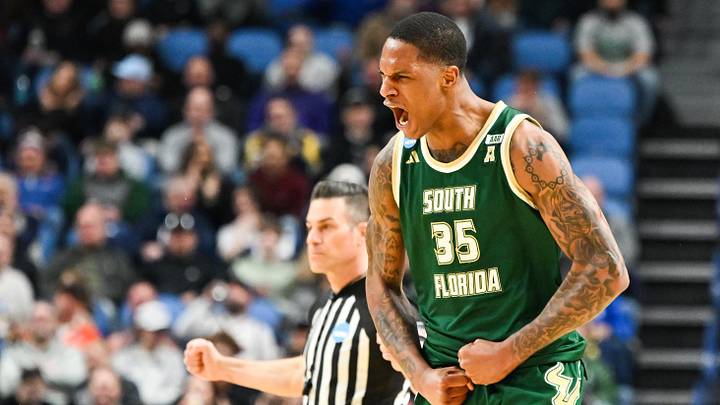
True to form, the Magic drafted USF forward Izaiyah Nelson -- with his 7-foot-2.5 inch wingspan (against being 6-foot-8.25 without shoes) -- with the 51st pick, adding some frontcourt depth to a team looking for more above-the-rim play.
The initial reaction from fans focused on the trade. And maybe there is something to be said about passing on two other center options that feel like more traditional centers than Nelson.
But ultimately, the Magic got a player who fits their type, fills a potential need and has a skill that is always in demand even if he is not perfect. It is the 51st pick, after all.
Nelson fills a clear need
It is unfair to put all the anxieties of Orlando Magic fans have about their front office on a rookie. This is a day for Izaiyah Nelson and his family to celebrate, and he deserves the chance to show what he can do.
Beyond all the frustration ultimately leading up to the pick, Nelson is someone who not only fits the type of player the Magic typically draft, but also fills a clear need for the team.
Nelson has all the measurables the Magic typically like in a player. He measured at the Combine at 6-foot-8.25 without shoes and a 7-foot-2.5 wingspan. He had a 9-foot standing reach.
That certainly suggests he can play bigger than his height. He will need all of it to make up for his lack of size to play as a center in the league.
He also had a 32.5-inch standing vertical leap and a 38.5-inch max vertical leap -- about in the middle of the pack for the NBA Draft Combine.
How does that all translate on the court? It translates into a bullish player who is smart and switchable on defense and can work around the rim and the glass.
Nelson averaged 15.9 points, an AAC-leading 9.6 rebounds and 3.0 stocks per game (1.6 steals and 1.4 blocks per game). He added 4.0 offensive rebounds per game in his first season in the AAC after transferring from Arkansas State.
He is not going to do much outside the paint. He shot an AAC-leading 56.1 percent from the floor and 63.0 percent on 2-point field goals. He shot 7 for 49 from three overall (14.3 percent). This is a pure rim-runner and putback player. Nobody should be asking him to do more.
According to Sports-Reference, he led the American Athletic Conference in defensive win shares (2.3), total win shares (5.8), and offensive box plus-minus (5.9), defensive box plus-minus (3.3) and total bos plus-minus (9.2).
In the NCAA Tournament against Louisville, he had 22 points and nine rebounds, including five offensive rebounds.
If effort is half the battle, Nelson is full of it. And that can translate into the spot the Magic will surely put him in.
The other options
It is the Draft. And unfortunately evaluating the Draft is a matter of preference in a lot of ways and what-if in many others.
Orlando Magic president of basketball operations Jeff Weltman has not even had the chance to speak to the media to explain his trade or his pick (and he may not until the team arrives in Las Vegas for Summer League) before fans went wild criticizing the decision to trade down.
Even taking an undersized center dependent on his length drew some criticism.
After all, if the Magic were looking for a big man who cannot do much scoring, they initially selected one at No. 46 in Felix Okpara, who averaged 8.0 points, 6.3 rebounds and 1.5 blocks per game at 6-foot-10 with a 7-foot-2 wingspan.
The favored target of most mock drafts was the raw Virginia center Ugonna Oneynso, who ended up getting picked with the 53rd pick and traded to the Detroit Pistons. Similarly, the 6-foot-11 center with a 7-foot-4.5 wingspan, did not put up impressive averages with just 6.5 points and 4.9 rebounds per game, but he did average an ACC-leading 2.9 blocks per game.
Both Okpara and Onyenso look more like traditional shot-blocking centers.
The answer may simply be that Nelson is a more versatile and refined version. He can do more things with the ball around the basket and is a cleaner and more determined rebounder. More than that, he does not need to be a drop big, able to switch onto the perimeter as evidenced by his steals.
That versatility appears to have won the argument in the Magic's draft room.
It is likely asking a lot for the 51st pick in the Draft to make a clear impact. It is very rare for players this deep into the Draft to carve out roles in the rotation. Maybe that is an excuse to take a big swing.
But if Orlando has proven one thing in the wake of the past offseason, it is how much the team trusts its process and its markers for better or for worse. Nelson checked every one of those boxes, and he was the option most likely to contribute quickly.
Time will tell whether Nelson can carve out a role immediately as a rookie or whether he will be another forgotten second-round pick.
The reason the Magic favor length the way they do is he has all the tools to be successful.
 Add us as a preferred source on Google