

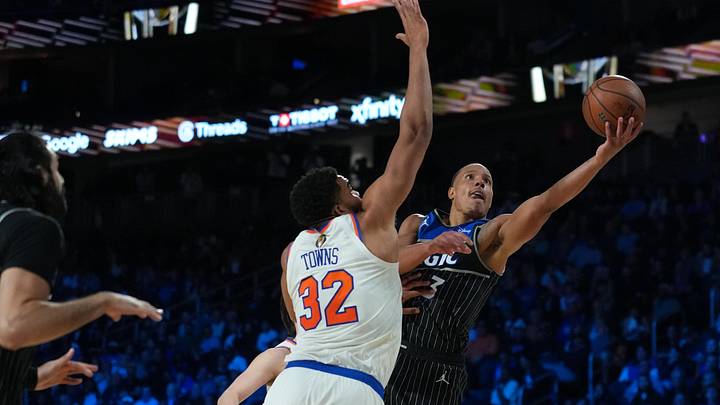
One year ago today, the Orlando Magic's future changed completely.
The team made a surprising bit of news on an early Sunday morning during the NBA Finals when it acquired Desmond Bane from the Memphis Grizzlies.
For a Magic team that has been so hesitant to make trades, it was a bold statement. It was an all-in moment, showing the franchise's belief in the team that it could compete for something bigger.
Nobody even realized Bane was available. He was the model for the kind of player the Magic would need. But nobody thought they could get the ideal version of what the team needed in a shooter and secondary creator.
The trade worked on his part. He was arguably the team's MVP (article forthcoming). And changed what this team could become.
Bane's arrival brought expectations not only internally but externally. The Magic were a darling pick to make it to the Eastern Conference Finals. Everyone expected them to take a step forward after their first-round exit as the 7-seed in the 2025 Playoffs.
This offseason is reckoning, then, with the team's failures.
It is reckoning with why things went so wrong and why the Magic are left asking themselves much bigger questions after a first-round series loss, a 3-1 series lead lost and an 8-seed in a season that featured so much promise.
Orlando's future is no longer inevitable. The team will not have the same external expectations. Even the die-hard fans will likely be circumspect about the Magic's chances. The Magic have a lot to prove.
But the path to a championship is often built on failures. It is built on how teams respond to failures. If a title is the ultimate goal, there is a lot of striving and failed attempts to get there.
A championship is rarely a straight line. It is rarely built in a single season. Championship teams often go through years of falling short and questioning themselves before they finally make their breakthrough.
It is all about how you respond to falling short and making the right decisions in the wake of failure.
In this age of parity with eight different champions in the last eight seasons, that is increasingly the lesson the team should learn from the NBA's champions. It is what they should learn from the New York Knicks.
The Knicks' path is littered with disappointment
The New York Knicks have entered the last few seasons with championship expectations. But like it took Michael Jordan seven years to win his first title or the Oklahoma City Thunder did not become some inevitable dynasty, the path to get to the title they won Saturday was a rough one.
Jalen Brunson joined the team in the summer of 2022. It took the Knicks five years to become a champion with shrewd moves and Brunson blossoming into a superstar player.
There were many questions and doubts along the way.
Brunson's impact was pretty apparent early on. The Knicks went from 37-45 and out of the Playoffs into a perennial 50-win team. They won 47 games that first season and took out the Cleveland Cavaliers in the first round. They failed to topple the 8-seed Miami Heat.
That was a first lesson.
So too was another second-round defeat in 2024, falling to the Indiana Pacers in the second round after dispatching the Philadelphia 76ers. That season netted them OG Anunoby. But it did not get them any further.
They traded for Karl-Anthony Towns ahead of the 2025 season, but they again wer met defeat. They made the Eastern Conference Finals but fell to the Pacers again. They fired Tom Thibodeau and there were plenty of questions about whether the team could function with this roster.
The Knicks took and learned from all those failures. They took small steps -- perhaps too small for an impatient fan base -- and slowly improved. They slowly got further in the postseason.
And even through all the doubts and questions, the Knicks kept their heads down. They answerd those challenges.
This was their breakthrough. One years in the making.
How the Magic respond to their failures
It takes a full organizational effort to build a champion.
The players have to be right and play well, of course, but the front office has to make the right decisions and right trades to support them. The right move or the wrong move can derail their hopes.
Ultimately, a championship is built on how teams respond to their failures. What lessons do they learn from falling short? How do they move forward?
This is what defines a champion. The Knicks made moves to improve and chased players to fill their weaknesses. They looked at their coaching situation last year and saw a tired team and sought a new approach while maintaining their defensive identity.
Everything fell into place perfectly for them. And the team performed at a high level using their experience to get to the top of the mountain at last.
The question is how do you respond to disappointment?
The Magic responded to the 2025 season's failure by chasing after an impactful addition in Desmond Bane. That was a roster- and paradigm-changing move. It worked on an individual level.
The Magic have already responded to their failure in 2026 with a change in voice. They hired Sean Sweeney to build on their defensive foundation while providing a new voice and new ideas to the team.
Orlando needs its stars to be healthy, obviously. That is where everything begins. The Magic showed they could compete with the best teams in the East when their roster is healthy -- including against the New York Knicks.
The Magic have plenty they must respond to from the last two seasons on the court as much as off the court.
Nobody knows if the pieces of this puzzle ultimately will turn into a champion. But the Magic are on that journey to find out.
As disappointing as the last two seasons have been, they are moments to learn. Whether the Magic are ultimately successful depends on whether they grow from these moments and whether their failures become stepping stones to their title.
 Add us as a preferred source on Google