

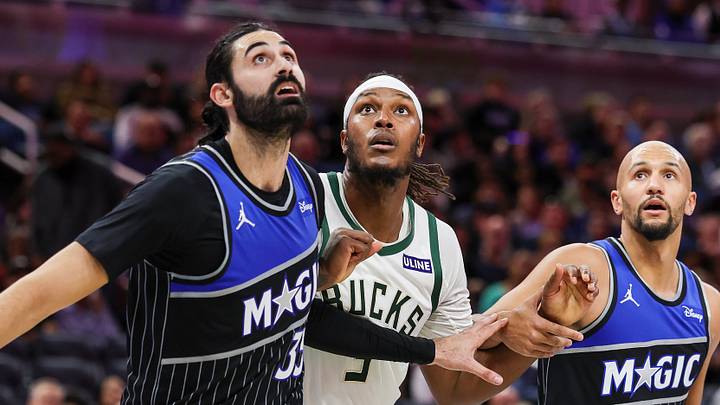
Orlando Magic coach Sean Sweeney was a bit puzzled by one thing in his team's early-season struggles.
He inherited a team with a sense of what its identity should be. The group had built success and a reputation for being elite at a few things.
Yes, Sweeney would need to rebuild a defense that slipped to 13th in the league last year. But they had the bones of what was once an elite defense.
But they started the year slowly on that end.
Part of it was their poor shooting leading to long rebounds. Part of it was their turnovers giving away extra possessions. Part of it was certainly the team learning new defensive principles, communication and rotations.
The one thing the Mgaic likely did not count on was the team taking a sudden turn in rebounding.
As Sweeney mused a few weeks ago on the team's poor start on the glass, he was confident they would find it again. After all, this team was fifth in the league with a 71.0 percent defensive rebound rate. This is mostly the same group. That should have carried over.
It was confusing then that the Magic started the year so poor on the glass.
If you are looking for a reason the Magic have turned things around, it starts with their rebounding and securing possession.
"Coach has really emphasized it since we had those issues early on," Goga Bitadze said after practice Sunday. "We trust them. If something is not going our way, we have to look in the mirror and know we put it on ourselves. If we can make something better, and work on it, we've got to do it."
After a slow start on the glass, the Magic are now sixth in the league with a 70.2 percent defensive rebound rate. That number has steadily climbed as the Magic have improved and gotten back on the winning track.
That improving rebounding number is also raising other parts of their game.
And that does not get into the team ranking 16th in offensive rebound rate at 31.7 percent and 11th with 16.0 second-chance points per game.
Rebounding is central to the Magic's success. It has been central to the team's turnaround.
Rebounding turnaround
One of the reasons the Orlando Magic got off to such a slow start was their poor rebounding.
In the first six games of the season, the Magic lost the rebounding battle in four games and gave up at least 10 offensive rebounds in five of those games.
The Magic ranked 27th in the league with a defensive rebound rate of 64.0 percent through the first six games of the season. They were 25th in offensive rebound rate at 29.2 percent. That, and the turnovers giving away possessions, put the team in a hole.
It hit its low with that loss to the Boston Celtics when the Magic gave up 14 offensive rebounds and 15 second-chance points in a tight game where turnovers and fouling were also issues.
Since then, though, the Magic are first in the league with a 77.3 percent defensive rebound rate and 12th with a 34.1 percent offensive rebound rate. They lead the league, giving up only 8.2 second-chance points per game, and are fourth with 19.0 second-chance points per game.
Winning the rebounding battle has been a good focus to help change things around.
"If we know it's going to help us win games, we have to do it and show them that," Goga Bitadze said after practice Sunday. "We have to keep building on that. When people go down, we come together. We have to play tougher because we're missing huge pieces."
The basics are still the basics for a reason. And no good defensive team can function if they cannot finish possessions with a rebound.
Orlando struggled with rebounding early in the season. Coach Sean Sweeney surmised that perhaps the emphasis on pace had players leaking out to get in transition before securing the board. The team has focused on having everyone crash the boards to help.
With Orlando's size, the team should be able to rebound effectively. So much starts from these basics.
Rebounding changes everything
The correlation between the Orlando Magic's rebounding during a rough 2-4 start and going 3-3 in the last six is evident. It has stabilized things for the Magic in a major way.
It has helped the team start to look more like the team it wants to be, particularly on defense.
In the team's first six games, the Magic had a 116.9 defensive rating, good for 25th in the league. In the last six games, Orlando has a 109.9 defensive rating, good for eighth in the league. The Magic have seen a positive correlation between their rebounding and their defensive output, with a few outliers among them.
"I think principle-wise, nothing has really changed there in terms of we want to turn and check to see if our guys is crashing," Sweeney said. "We want to turn and hit if he does. If he does, we have to make sure we get back into the fight. The one thing I think if you look at our shot profile defensively, we are forcing more tough shots so to speak."
The team settling in more on defense has helped settle the team on the glass and finish these possessions.
Indeed, through the first six games, Orlando gave up 49.0 points in the paint and 20.8 wide-open field goal attempts per game (at 40.0 percent shoting). In the last six games, the Magic are giving up only 36.0 points in the paint per game and 20.2 wide-open shots per game (48.8 percent shooting).
There is still plenty to clean up defensively. The Magic's pressure scheme is still getting fine-tuned.
But it cannot make progress without the Magic locking down the glass. And that has been the biggest turaround in the early part of the season.
Securing the glass is always a good place to start. Or the place to finish.
 Add us as a preferred source on Google