

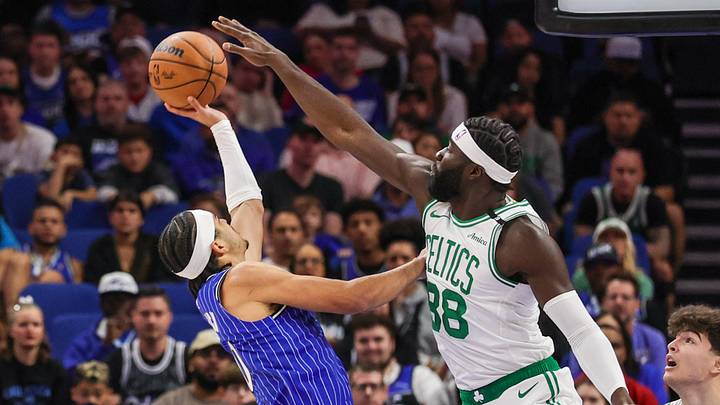
The Orlando Magic started off Sunday's game against the Boston Celtics about as well as they could, racing behind hot shooting to a 13-4 lead.
Then it started to fall apart, in a meltdown reminiscent of Wednesday's 30-point loss to the Toronto Raptors. Seven turnovers in the final 8:17 of the quarter and five offensive rebounds. It added up, putting the Magic on their back foot.
They made six 3-pointers and 53.3 percent of those shots in the opening quarter. But instead of controlling the game and opening a big lead that they could manage, the Magic's turnovers and poor rebounding left them down by one.
That has been the story all season. How the Magic fell behind the Celtics and had to climb uphill has been a lot of self-inflicted wounds. The Magic keep losing the possession game.
Yes, Orlando ultimately fought back from a second-half 15-point deficit. They had a tie game with 10:52 to play -- turning the ball over with a chance to take the lead and sparking a 16-6 Celtics push to put the game out of reach.
The fourth quarter became about the Celtics' shot-making in a 108-97 victory at the Kia Center on Sunday.
"I think we got in our own way a little bit," Tristan da Silva said after Sunday's loss. "Not sticking to the fundamentals that we want to play with and making sure we get a shot off every possession. For the most part, when we did trust the paint and play off two feet and trusted the pass and shared the ball, we got good looks, and most of the time was a good result. We gave too many possessions away."
But that was all set up once again by a Magic team falling behind on the possession count. Their comeback came simply because they stoppped turning the ball over and began making up ground.
The Magic's key to success is finding a way to win the possession battle again.
An early-season struggle
These self-inflicted mistakes are a big part of the Orlando Magic's struggles to start their season.
They have played from behind in virtually every game this season -- trailing by at least 10 points in every game but Friday's win over the Toronto Raptors. They have spent much of their time coming from behind.
A big part of that is because they lose the possession battle.
Orlando currently ranks 25th in turnover rate at 17.3 percent. The team ranks 27th in the league with a 64.0 percent defensive rebound rate.
In Sunday's game, the Magic tunred it over 18 times for 21 Celtics points. They had eight of those turnovers in the first quarter when they missed their chance to expand an early lead.
Coach Sean Sweeney credited the Boston Celtics' defense for their ability to swarm the ball. They are good at forcing turnovers. The Magic have instructed players to make decisions off two feet rather than jumping in the air and making late decisions.
The possession problem becomes bigger when you add rebounds to the equation.
Boston tallied 14 offensive rebounds for 15 second-chance points, making 5-for-13 on second-chance opportunities.
Anthony Black said the team has lost some size with Paolo Banchero and Noah Penda out with injury. It is on the guards and wings to crash down and help the centers and forwards collect rebounds. It will take a team effort to improve this.
But the raw numbers are not quite the point. What has hurt is the lost opportunities that come with making these mistakes.
Boston had 10 more field goal attempts at halftime, helping stake that five-point lead and expand the lead in the second quarter despite shooting poorly from the floor and from deep.
It is about taking advantage of more opportunities.
"I think in the first half, we didn't do a great job on the defensive boards," Sweeney said after Sunday's loss. "In the second half, we did a good job. In general, that's a big part of the game on both ends. We did a much better job of crashing in the second half. If we can sustain on both ends, I think we are in great shape in our rebounding."
The Magic have given up more field goal attempts in every game this season.
This is the new math problem for the Magic. They get fewer opportunities and thus demand more efficiency, something that is still inconsistent and elusive to this team.
Proof in the comeback
If the Orlando Magic are looking for proof that their problems amount to these turnovers and offensive rebounds they concede, look no further than the comeback they made in the third quarter.
After trailing by 15 points with seven minute to play in the third quarter, Orlando put together a 20-5 run to tie the game at 74.
In that run, the Magic gave up one turnover and three offensive rebounds (all on the same possession that ended with a Jayson Tatum missed three). Orlando ate into the deficit because of a trio of triples from Desmond Bane and Trsitan da Silva.
The Magic got their shots in and their bites at the apple to close the deficit.
They won the possession battle with 55 field goals and free throws to the Celtics' 52.
"I think that's also what gives us a lot of hope is seeing that all of these empty possessions that we are having are really self-inflicted," Tristan da Silva said after Sunday's loss. "Just being able to actually play it out and take advantage of those possessions is going to help us big time. That's offensive rebounding, that's finishing possessions and taking care of turnovers."
It did not result in a win -- the Celtics won the half 53-47 because of their strong defense. But the Magic gave themselves the chance to win in the fourth because the defense could get settled after a half full of turnovers and missed opportunities.
There is something to work with overall. So much of it starts with securing possessions and being able to control the tempo of the game.
That is something Orlando is still missing this year. If the team wants to right the ship, that is where the team must start.
 Add us as a preferred source on Google