

The Orlando Magic were in the fight for a quarter and a half.
They took an early nine-point lead and seemed to have the energy overflowing from their victory on Sunday against the New York Knicks.
Defenders were contesting everything at the rim. They deflected passes to get steals and out in transition. The ball was moving and flowing. The team was playing with energy.
Then the snake began to tighten its grip.
That is what the Toronto Raptors do. They close down driving lanes, sit on spinbacks, and get their hands on everything. No pass to the perimeter is clean or simple. Every mistake is paid for.
The Magic fought for as long as they could. But when the turnovers started coming fast and frequently at the end of the first quarter, it already felt like it was too late. There was no room to move.
The Magic had seven turnovers in the first quarter and 14 at the half. What was a close game through much of the second quarter extended to double digits and then to 16 by halftime.
They only further increased their grip on the lead to start the third quarter. The Magic never could breathe in a 129-99 loss at Scotiabank Arena.
The Raptors pummeled the Magic as the misses and turnovers piled up, getting out in transition for 23 fast-break points. The Magic were left trying to figure out who to guard and find their footing.
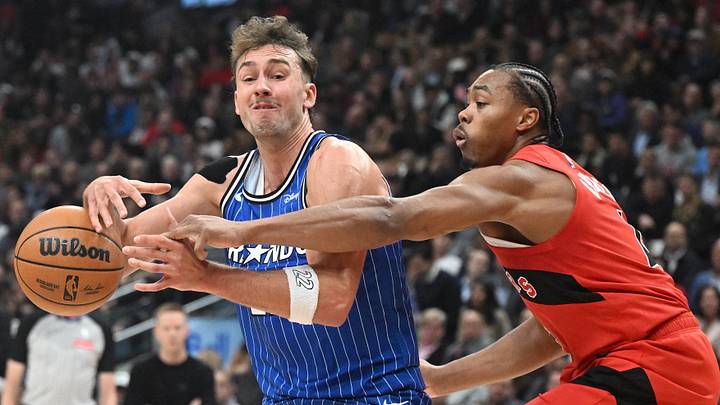
Franz Wagner finished with 15 points on 4-for-11 shooting with five assists and seven turnovers as Scottie Barnes and the Raptors' defense bottled him up.
Desmond Bane had 13 points on 2-for-8 shooting from deep. Tristan da Silva scored 20 points and made four of five from three, accounting for nearly half of the Magic's 3-point makes (10 for 35).
But the Raptors had far more balance. R.J. Barrett scored 21 of his 25 in the first half, getting to the rim with some ease. And Scottie Barnes dominated the second half with 18 of his 28.
The Magic did not seem to have the energy or the will to fight back against the pressure they were put under.
Lacking creation
The Orlando Magic's biggest problem has always been a lack of creators off the dribble.
Their playoff series during the last three years have often felt like Paolo Banchero and Franz Wagner banging their heads against a wall, trying to find a way through. They had to carry such a huge burden.
What that looks like without Paolo Banchero and Jalen Suggs, two of the Magic's few players capable of bringing the ball up, initiating actions and giving the other star players a breather to work off the ball and find advantages to exploit, should not be too surprising.
Especially against a heavy ball-pressure defense like the Toronto Raptors.
The Raptors are known for pouncing on turnovers.
So when Wagner struggles to initiate actions, everything else will grind to a half.
Wagner accounted for seven of the Magic's 14 first-half turnovers. The Raptors had 13 points off those turnovers, a credit to the Magic's defense. But all of those extra possessions were eventually going to cost them.
That is how the Raptors built a 16-point lead. And the Magic's offense looked like it could not create much consistently.
Toronto ended up forcing 20 turnovers for 20 points. With so little margin, the Magic could not afford to give those posssesions away.
Three-point variance
The Orlando Magic are trying to shoot a lot more 3-pointers this year. That is at least a good idea. More volume gives more opportunities to make those outside shots.
The question is whether the Magic will make any more or improve their percentage.
Orlando is making more threes. But the percentages have been up and down. The Magic have had some really good moments and some frustrating moments.
With how stuck the ball was with the poor ball movement and the Toronto Raptors' pressure defense, the Orlando Magic struggled to get the quality looks that they can make.
Orlando finished the game 10-for-35 (28.6 percent), including 8-for-27 (29.6 percent) through three quarters (the starters mostly sat the fourth quarter). The Magic were not making threes.
The Raptors entered the game shooting 26.2 percent from three, the second worst in the league to this point. That was inevitably going to change.
Orlando got caught holding the bag when that did change.
The Raptors made 15-for-35 from three-point range, including 8-for-18 in the first half. That helped the Raptors take the lead in the first quarter and gain distance in the second quarter.
From there, the Raptors were the far more confident team and left the Magic searching. It was their night.
Missed Opportunities
The first four games of the season have all seen the Orlando Magic fall behind by double digits. Every game has seen the Magic enter the half trying to climb uphill. This team has not played from ahead.
Just like the previous three games, there were several moments when the Magic cut into the lead and build momentum. And just like those games, the Magic seemed to drop the ball.
It could be a quick shot or a rushed three. It could be a turnover. A missed layup. A missed free throw -- the Magic went 23 for 29 at the line, but were 12 for 17 in the first half when the game was tight.
And often those mistakes lead directly to points on the other end that expand the lead back out to double digits, leaving the Magic to roll the boulder back up the hill.
Eventually that constant traveling uphill wears a team out. It beat them in the losses to the Minnesota Timberwolves and Toronto Raptors. They found a way to get over the hump to defeat the New York Knicks.
But it is wearing. The Magic have to keep games closer.
Orlando has beating itself as much as anything else in these games. And cleaning up those mistakes and seizing their opportunities is a big thing the Magic are missing.
 Add us as a preferred source on Google