

When Orlando Magic fans looked at the schedule this week, they saw relief.
The Phoenix Suns had only one win entering Thursday's game. So too did the Sacramento Kings, Utah Jazz and Milwaukee Bucks. After a difficult opening to the season, only the Golden State Warriors loomed with a winning record.
Four of those five opponents had defenses in the bottom 10 in the league. Three of those five are in the bottom 10 in opponent turnover rate. The hope that the Magic would be able to get their offense right seemed apparent.
All the Magic needed to do was take advantage of the opportunity. They just needed to do the basics to win.
But Orlando, now at 2-6, cannot even think about picking off opponents on their schedule. They are facing a much tougher opponent than the leaky defenses in front of them:
They continue to beat themselves.
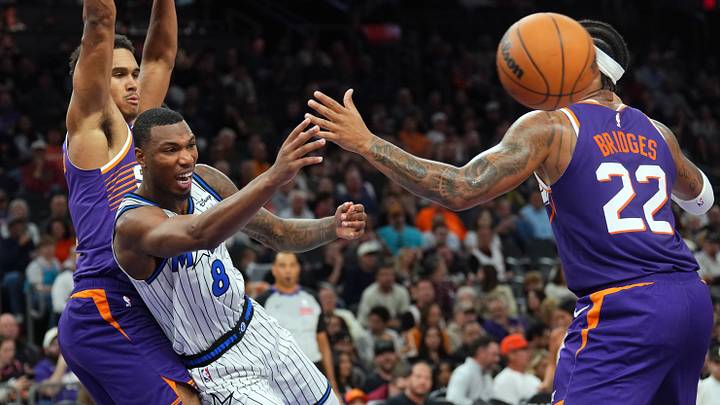
The Magic's chance to defeat the hapless Suns disappeared almost immediately. The Magic had nine turnovers in the first quarter, falling behind by seven points at the quarter break. They added another 10 turnovers in the third quarter as the lead ballooned to 30 points in a 117-103 loss.
The Magic did not give themselves a chance. They ended the game by handing it to the Suns. And all of them in a variety of ways.
"We had them in a lot of different ways," coach Sean Sweeney said after Thursday's game. "I think the illegal screening, some decisions where we were a little careless with the basketball. Some plays, I thought we tried to make the right play and just didn't connect the dots. A number of them in a number of areas. When you have 25 turnovers, it's not just one thing per se but a number of them.
Through three quarters, the Magic had a 29.9-percent turnover rate as mistakes compounded and grew. That is simply a hole too deep for any team to dig itself out of. Defensive collapse was inevitable.
Before the Magic can even think about anything else, they need to get their house in order and their execution.
The turnover problem has been growing
The turnover problem has been nothing new for the Orlando Magic this season. It has dogged them in the preseason and has not found any resolution now that the games are counting.
Some mistakes were expected, with the Magic learning a new offensive system, new reads and placement on the floor. Orlando has not sweated all of its turnovers and has acknowledged this learning curve.
Still, things should not look this bad.
Orlando ranks 28th with an 18.6 percent turnover rate. The team averages 18.3 turnovers per game and gives up 21.1 points off turnovers per game. All of those are in the bottom five in the league.
The Magic have three games with at least 20 turnovers this season. Orlando has two games with a turnover rate of at least 20.0 percent.
For some perspective, the Magic had just four games with a turnover rate of 20.0 percent or worse last year and five games of 20 or more turnovers.
The Magic were never the greatest team at protecting the ball, but they were not giving it up at this rate.
Thursday's game featured a season-worst 24.8 percent turnover rate. That number was 29.9 percent through three quarters, when the Suns essentially put the game out of reach.
"I think it's just decision-making," Wendell Carter said after Thursday's game. "We have to do a better job of when we get in certain positions on the court making better decisions. And the guy receiving the ball has to be in a better spot. It's a connection thing. Something we just have to be better at top-to-bottom."
So much of the NBA game is about the possession game now. Teams that get more field goal attempts get more chances to score. Offenses can be so efficient now that giving them extra chances is simply a non-starter.
But that is what the Magic are doing. They are handing extra possessions to their opponent. Any team will take advantage of that.
The Suns scored 36 points off 25 turnovers, the most points off turnovers for the season. Entering the game, the Magic were at least good at preventing points off turnovers with 19.0 per game despite their excessive miscues. That shift was too much to overcome.
This was execution and reads. The Magic were simply not on the same page and looked lost within their offense.
When the Magic don't turn the ball over
The Orlando Magic's offense has obviously suffered from all the turnovers.
The team is scoring only 107.4 points per 100 possessions. The team might be taking more threes, but they are not scoring more points.
The turnovers are a drain. They are empty possessions. And teams cannot survive without them.
"Honestly, we gave them the ball," Wendell Carter said after Thursday's loss. "I don't necessarily think they did anything insane or anything crazy that was hard to guard. When you give up the ball 25 times, anybody has the chance to beat you."
But what happens when the Magic do not turn the ball over? What happens when the team actually executes what it is trying to run?
Orlando has struggled to put together a full 48-minute effort. But in the pockets the team avoids turnovers, the results are promising.
The Magic's offense features far more passing and player movement. When the team gets downhill and touches the paint, it finds open shooters. Wendell Carter is feasting in the dunker spot.
After a nine-turnover first quarter, the Magic turned it over just four times in the second quarter. The Magic were 1-for-8 from three (0-for-5 on wide-open threes) and got to the line for 14 free throws (making only eight). The Magic took more field goals than the Suns in the quarter.
They were set up to take the lead simply because they were getting shot attempts.
In the fourth quarter, the Magic cut a 30-point deficit to 13 and made the Suns bring their starters back in. They turned it over only twice and stated making shots to cut into the deficit.
That quarter might not tell anyone very much. But it was a sign of how quickly the Magic can build offensively when they simply get the opportunity to score.
Clearly solving the turnovers and giving themselves the chance is the first step to making progress. The Magic are not beating anybody until they give themselves the chance.
 Add us as a preferred source on Google