

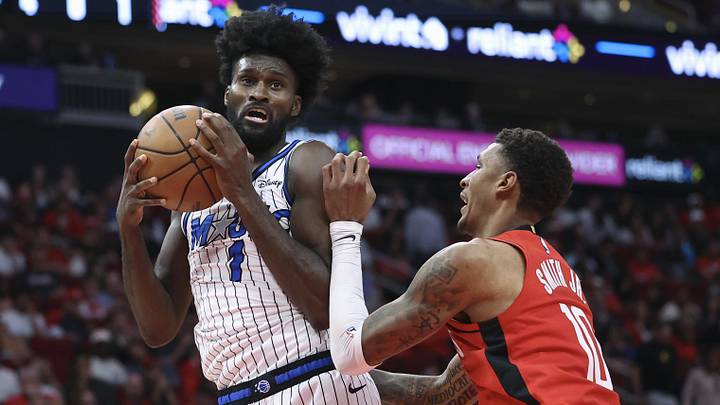
The writing was on the wall when the two sides agreed to change the guarantee trigger on Jonathan Isaac's contract back in February, and it became public in March. The Magic and Isaac were heading for a split after nine seasons together.
The knee injury that ended Isaac's season -- quite ironically in his 53rd game, which would have guaranteed his full salary without the amendment -- only made the split that much more sour. A season full of injuries would end with a minor injury, taking away another key player for the team's last-gasp playoff run.
The inevitable became reality on Saturday.
With a trade always unlikely for Isaac and his $14.5 million salary ($8 million guaranteed if he is waived by June 28), the Magic officially severed ties with their long-time forward. The long journey with Isaac's injuries, the promise of his defense, and the disappointment that he could never quite return to form after his devastating absence is at least over for now.
The Magic included this out in Isaac's renegotiated contract from the summer of 2024 in case he struggled with his health, considering he missed two full seasons and then suffered another major injury after returning in 2023. But in reality, Isaac's departure in this way is a product of the Magic tightening their belts. They are reducing their tax payment and giving themselves a bit more flexibility.
That is all relative. They are still projected to be above the first apron next season -- mostly meaning they cannot take on more money than they send out in trades and limiting them to the taxpayer mid-level exception of $6.1 million.
Even if the Magic maximized all the cap room they could have this summer, they would not have much more to use than the taxpayer mid-level exception in free agency. It is one of the reasons the Magic needed to explore whether anyone would take on Isaac's contract.
It was inevitable that the Magic would ultimately cut Isaac before this deadline and take some immediate tax savings. The question is whether the Magic can find any flexibility.
Some tax savings
President of basketball operations Jeff Weltman has been warning for several years that the penalties of the NBA's salary cap system would come for them eventually. This is the first offseason the Magic are suffering those consequences.
Weltman said the team was prepared to pay the luxury tax for the first time since the 2012 season. There is no avoiding that it seems with the salary commitments the Magic have made.
Jonathan Isaac is merely the first cost-cutting casualty.
It did not help that his play had dramatically decreased in the last few years. The Magic stayed invested in his elite defensive potential after he missed most of three seasons recovering from a torn ACL. The Magic could never get him physically right to mimic the elite defense they had banked on him returning to.
With no trade options, cost savings seemed the best solution to maximize their present.
Isaac's contract is guaranteed for only $8 million of the $14.5 million he was owed for the 2027 season. That $6.5 million savings will not dip the Magic below the first apron, but it will give them slightly more flexiblity.
As things stand, the Magic have $207.9 million in projected guaranteed salary for the 2027 season, according to Spotrac. The salary cap is projected to be $165 million, the luxury tax line is expected to be $201 million, the first apron at $209 million and the second apron at $222 million.
Waiving Isaac drops the Magic briefly below the first apron, but not enough to gain access to the non-taxpayer mid-level exception. The Magic still have three roster spots to fill.
This also does not include Jamal Cain, who has a team option that must be exercised by Monday. His $2.6 million salary would put the Magic back above the first apron with plenty of room before the second apron -- not that the Magic can do much more than sign a player to the taxpayer mid-level exception of $6.1 million and minimum salaries.
This does not include Izaiyah Nelson's second-round contract (which would cost another $1.4-1.5 million).
Even with this move, the Magic will be above the first apron.
The stretch dilemma
The debate that is really ongoing is whether this is it for Jonathan Isaac.
Jason Beede of the Orlando Sentinel reported the Orlando Magic did not intend to stretch Isaac's salary cap hit over seven years and intended to leave the full $8 million on their salary cap sheet for the next season.
If the team did that, it would decrease Isaac's cap hit from $8 million to $1.1 million and leave them with $203.7 million in guaranteed salary (including Jamal Cain's team option).
That leaves the Magic $5.3 million beneath the first apron.
There is certainly some benefit to that. It does not give the Magic access to the non-taxpayer mid-level exception. But it would allow the Magic to make trades where they take back some more salary. That is actually a really powerful tool and expands some possibilities.
There is a reason to stretch Isaac's salary, even if it means a small amount sits on their books until the 2033 season. That ability to take on some more salary would be quite valuable.
The good news then is the Magic do not have to make the election on Isaac's salary until Aug. 31 (per Article VII of the CBA). Like cap holds, the team can flip them on and off as they need them.
The Magic appear to have a little more flexibility than they did before.
But the reality remains that the Magic will be limited in free agency to minimum salaries and the taxpayer mid-level exception. Losing Isaac's $14.5 million eliminates any major changes.
The Magic can take on a little bit more than Goga Bitadze's $7.6 million in a trade. But even that will not make a huge dent.
The other thing to note is that u
When it is all said and done then, the Magic's gamble on Isaac failed to pan out. The team gave itself an out. But it still has the team stuck and searching for some flexibility to make moves this offseason.
 Add us as a preferred source on Google