

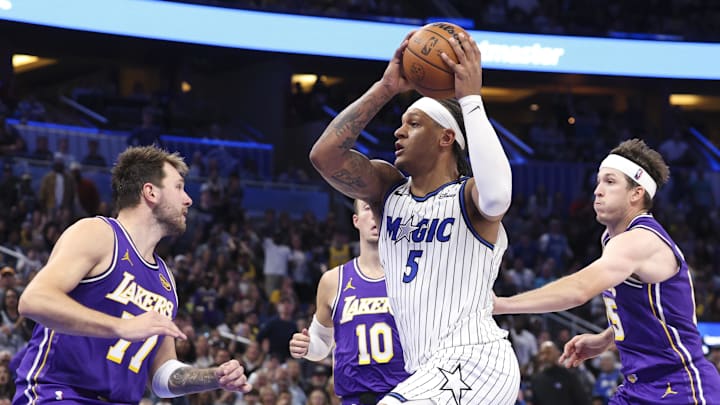
Saturday's 105-104 loss to the Los Angeles Lakers had the feel of a Playoff game.
The pressure to execute was at its highest. The stakes felt really big with both the Lakers and Magic needing the victory to keep pace in the standings. The disappointment in the Magic's defeat and frustration over dropping that game were very real.
The crowd -- the second largest in Kia Center history with a healthy mix of Lakers fans in attendance, as always -- certainly gave it a playoff atmosphere.
It was not a playoff game. There are still 12 games remaining, and still time for the team to make up ground.
But the defeat on Saturday and how it unfolded was a reminder of a critical truth about the Magic. Orlando's offensive execution in the half-court still leaves a lot to be desired, especially when games get tight.
The Magic had several opportunities to put the game away Saturday, and each time the Magic hit a wall, unable to finish the game on the court.
The game felt like a playoff game because of how critical the team's half-court execution was. The game slowed to a crawl. And the Magic struggled, not only failing to hit those critical shots down the stretch but scoring only 17 points in the fourth quarter.
"Just keep trying to create good looks, play intentional and smart, and I think in the same breath not eat up a ton of that shot clock where it makes it hard on ourselves at the end of the possession," Jalen Suggs said in the locker room after Saturday's game. "Not giving ourselves multiple actions and multiple chances to get good looks."
Saturday's game and its struggles were a preview of the familiar frustration the Magic could face in the Playoffs -- assuming they get there.
The Magic's offense is much improved this season. But it is not free from frustration. And that frustration is still the ability to grind out possessions, execute and score when defenses are set.
That is what Playoff basketball is about. And Saturday's loss was a reminder of how much the Magic still struggle and the big part of the team that might still be holding them back.
An improved offense
Much of the Orlando Magic's offseason and training camp focus was on getting out in transition more and trying to use that defense to create more offense for this team.
It does not always feel like it. But Orlando's offense is vitally improved.
The team ranks 17th in offensive rating at 114.1 points per 100 possessions. That is not good, but the team would take being league average if its defense remained elite. The Magic are 14th since the All-Star break at 115.5 points per 100 possessions.
The Magic average 15.9 fastbreak points per game, 12th in the league. They are ninth in the league with 115.0 points per 100 transition possessions, according to data from Synergy.
The problem remains the team's half-court offense. That is what matters in the Playoffs when games slow down. And it has haunted the Magic for a long time.
"That's a good question. It's something that we kind of struggled with throughout the whole year," Wendell Carter said after Saturday's game. "A night like tonight, they stalled us out a lot by switching everything. It made it tough to create an advantage. I think in-game we just have to do a better job, figuring out how to create an advantage. The quicker we can adjust to it and figure it out, the better we will be offensively."
Despite all those offensive improvements, the Magic are still 19th with 96.9 points per 100 half-court possessions, according to data from Synergy. They were 27th at 93.3 points per 100 possessions last year, still a marked improvement.
But only four postseason teams -- the Philadelphia 76ers, Houston Rockets, Portland Trail Blazers and Phoenix Suns -- are worse in the half-court. And those are not exactly teams that are expected to go deep into the postseason.
That is ultimately where Orlando wants to be. The team needs to find a way to execute more effectively.
The game slows down
The concern for the Orlando Magic is that the playoffs will see the game slow down. Half-court execution matters the most. And while every team struggles more against set defenses, the best teams are the ones that can execute.
In Orlando's 10 lowest-possession games, the team is 4-6. Two of those wins are against the Brooklyn Nets and the others are against the LA Clippers and New Orleans Pelicans. Saturday's game was the 10th-fewest possessions the team has played this season.
Conversely, Orlando is 7-3 in its 10-highest possession games this season.
The Magic have often struggled with pace. They can go too fast and the team does not want to get into a track meet. But the Magic's biggest weakness remains their inability to execute when the game slows down.
"You don't want to turn into a rat race down the stretch," coach Jamahl Mosley said after Saturday's loss. "You have got to make sure you execute the plays down the stretch that you need to. We got a couple of great looks. Some didn't go down. At the end of the day, we put the matchups that we needed. That's what you're finding. That's what the Lakers did as well."
Orlando struggled to get and make good shots down the stretch. They committed a 24-second shot clock violation and then settled for a Desmond Bane step-back with a three-point lead (granted the NBA admitted Deandre Ayton should have been called for a defensive three-second violation trying to deny Paolo Banchero a post entry).
It was not the first time the Magic struggled late in games. They had 17 points in the fourth quarter, eerily reminiscent of a 12-point fourth quarter against the Toronto Raptors in December.
The Magic have a sterling clutch record at 23-13. But they score only 109.0 points per 100 possessions. Most of their clutch play is holding on for dear life rather than pushing the tempo and scoring.
"We've just got to be faster and more physical," Wendell Carter said after Saturday's loss. "Especially in late-game situations, they allow us to play a little more. But I think it's safe to say you can be a little bit more physical later in games. Offensively, just be a little more crisp, understand their defensive schemes, and what they are doing. And then taking shots when they are open. Those things will always give us a good chance to win the game."
It is all part of the same problem when the game slows down.
The Magic know they will see games like Saturday in the Playoffs. And the Magic are still struggling to execute in the half-court when it really matters.
 Add us as a preferred source on Google