

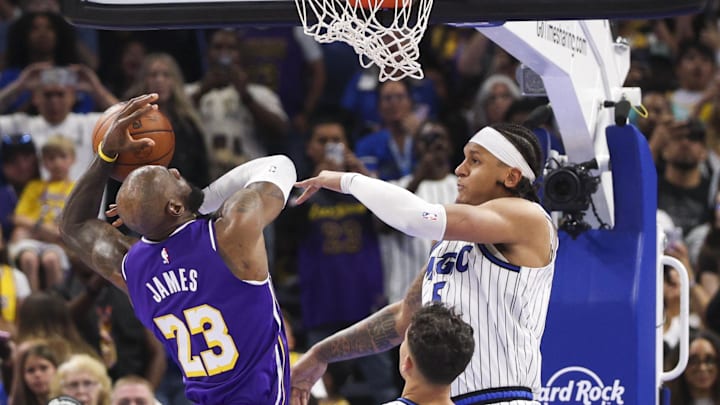
The question that will haunt the Orlando Magic for the next two days -- and perhaps deep into April as they fall further behind in the playoff race -- is how did Luke Kennard get so open for a game-winning three with 0.6 seconds left?
That question was stacked on top of so many other mistakes down the stretch of a winnable game that would changed the team's mood.
How did LeBron James get wide open underneath the basket, forcing Paolo Banchero into a desperation block that put 2.6 seconds left on the clock?
How did the Magic fail to inbound the ball, allowing James to knock the ball off Banchero with 5.5 seconds left?
How did the Magic miscommunicate with officials to lead to a timeout after Wendell Carter rebounded Deandre Ayton's intentionally missed free throw with a two-point lead?
The game was essentially decided on those three plays. Those short 5.5 seconds of gametime separated the Magic from euphoria to bitter disappointment. That is the reality of the league and the reality of these pressure-packed game.
In every instance, the Magic failed to execute what they needed to win the game. All anyone cares about is that final score. And it was the Lakers who delivered with that game-winning three as Paolo Banchero and Desmond Bane went with LeBron James toward the ball, leaving one of the best shooters in the league wide open for a 105-104 Lakers victory, their eighth in a row and the Magic's fourth defeat in a row.
Orlando again was left questioning itself and trying to assign blame to find solutions.
"As the PG taking it out, I have to either call a timeout or get the ball inbounds. It's tough to turn it over there," Jalen Suggs said in the locker room after Saturday's game. "I think it's just being precise at the end of the game with our cuts, with our getting open, and then with our switching. That's our loss for sure."
As coach Jamahl Mosley repeated, the last three plays stand out. Those critical errors left the door open for the Lakers to win. But they were part and parcel to execution errors that have plagued the Magic all season.
Orlando stubbed its toe late in games -- as it has often done this season but been able to survive. It failed to corral rebounds, the team turned the ball over. The Lakers took the opportunity. But it was the Magic's continued self-inflicted wounds that cost them over and over again.
Mistakes adding up
The endgame mistakes were all part of the same problems that have plagued the team all year long.
The Orlando Magic have been far from a perfect team. But far too many games have come down to execution mistakes, focus and things the team can control. Many losses have come because of the team's lack of attention to detail.
For a team eyeing the Playoffs and aiming to do big things in the postseason, those especially hurt.
Late game losses tend to sting a bit more. This one stung because the Orlando Magic were one play each time from clinching the game, inviting the Los Angeles Lakers to steal the game from them.
Saturday's loss was all on the Magic. But not simply for the team's poor late-game execution.
Orlando has been statistically a good rebounding team, ranking sixth in defensive rebound rate at 70.6 percent. The team has statistically been good at protecting the ball and not turning it over, ranking sixth in turnover rate at 13.6 percent.
Yet repeatedly, both facets of the game have cost the team in games. Both cost the Magic on Saturday.
Orlando gave up 14 offensive rebounds for 19 second-chance points. The Magic might have given up fewer second-chance points than they scored (21), but those were still extra opportunities. Los Angeles had five offensive rebounds in the fourth quarter.
Similarly, the Magic turned it over 18 times for 22 points, squandering precious possessions in a game played at a pace of 95.5 possessions per 48 minutes. Each miscue felt bigger as the game got tighter.
Orlando had four turnovers for seven points in the fourth quarter. That included two turnovers in the final three minutes. One of them being the turnover on the inbounds that would have sealed the game at the foul line.
"We've got to do a better job of execution late games defensively," Wendell Carter said after Saturday's game. "That was two possessions P[aolo Banchero] was able to save the day for us on one and just a miscommunication not being physical enough, so that we could be able to switch. That's about it. We have to do a better job of it."
The Magic have made these critical errors all year. They have had games that went against their character all season long.
Those are all signs of how the Magic beat themselves.
Magic beat themselves again
This was a playoff-like game. It all came down to the little details that determine outcomes.
The Orlando Magic continued to struggle to make these plays.
They have allowed mistakes to pile up constantly, which ultimately bury them one way or the other. Nothing that happened in the final moments of the game was a surprise, given how the Magic flubbed opportunities throughout the game.
The Magic struggled to get a good shot after going up by five with 50 seconds to play, conceding a quick layup and not re-extending the lead.
The Orlando Magic put the Los Angeles Lakers in the bonus with 9:05 to play in the third and 6:34 to play in the fourth quarter. The Lakers shot 14 free throws in the third and six in the fourth on their way to 29 for the game.
The Magic were unable to extend a five-point lead with Luka Doncic out of the game to start the fourth quarter, leading by only three when he checked back five minutes into the quarter.
That was the same group that erased an early 14-point deficit as the Magic found themselves trailing by double digits once again to open the game.
These are all little things that add up in the course of the game. There are too many lulls and dead spots offensively and too much inconsistency and bad decision-making on defense that put the team in trouble and playing catch-up.
"We've got to be better in the beginning part of the game," coach Jamahl Mosley said after Saturday's game. "Can't have lulls. It came down to those last four plays essentially. Small things within the game cost it down the stretch. But we just have to be better."
These little mistakes have followed the team all year and have kept the team from realizing its potential.
They were always the thing that would cost them in the Playoffs. And now that the team is facing playoff pressure to avoid the Play-In, the team is seeing how costly those mistakes are.
 Add us as a preferred source on Google