

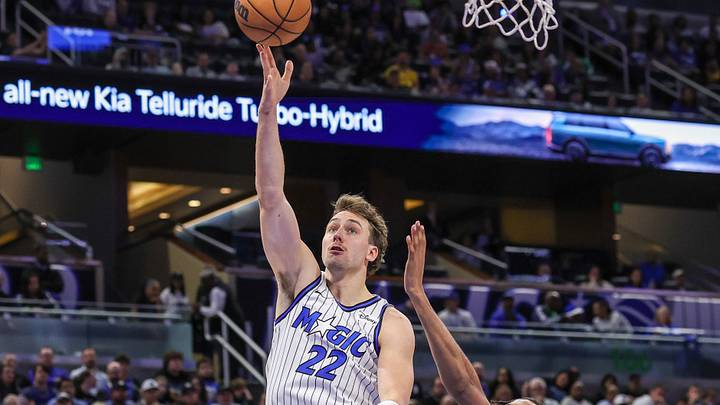
Ask anyone around the NBA, and they will tell you what the Orlando Magic's biggest problem is.
A 19-point second half in a Game 6 at home with the chance to advance screams loudly how much the Magic need more consistent scoring. Things fell apart too quickly for the Magic and their offense. Their shooting was too inconsistent. The offensive pieces do not fit together perfectly. Everything would bog down and just look slow.
The Magic have not had an offense in the top half of the league since the Dwight Howard trade in 2012. Scoring and shooting have been a problem for the Magic for a long time. And they remain big issues.
Whether Sean Sweeney can unlock new concepts and ideas on offense is one of the big stories for the upcoming season. The Magic had clearly outgrown what Jamahl Mosley was trying to run. It was not clicking.
Except, in many ways, it was.
Sweeney's first task with the Magic is not to reform the offense. It is to recover a top defense. That will help the offense tremendously too. The slip on defense hid some of the significant growth the Magic made on offense.
Considering Joe Prunty remains on staff and Sean Sweeney is hinting that pace and speed will be important pillars for the Magic's offense, the changes that went through last year are likely to stay.
The crazy thing to think about is that those changes worked. It was one of the quiet storylines from last season.
For all the criticism and frustration over the Magic's offense, it was still the best offense of Jamahl Mosley's tenure and the best offense the Magic have seen in more than a decade. There is something to build upon. However small that might be.
The Magic ranked 18th in offensive rating at 114.2 points per 100 possessions. That was only 0.1 points per 100 possessions behind the 16th-ranked Philadelphia 76ers. No one should aspire to be league average, but a league-average offense is attainable. It is a lot closer than it appears.
Before Franz Wagner's injury in December, the Magic ranked 11th at 115.7 points per 100 possessions.
The Magic can be a better offensive team. Like so many other things, it relies on health, a more efficient Paolo Banchero and the connectivity that Franz Wagner brings. The addition of Nikola Vucevic adds another key offensive weapon off the bench.
There are plenty of hidden signs of hope. The offense can improve.
The speed piece
The biggest thing the Orlando Magic aimed to solve last year was making more out of the turnovers they created. There was an emphasis on playing faster and getting more opportunities in transition.
After all, if the defense was going to be elite at forcing turnovers -- finishing second in opponent turnover rate in 2025 and sixth in points off turnovers per game -- the team should be better at converting that into points.
In 2025, the team finished 25th in fast-break points per game and 24th in transition points per possession and 26th in transition possessions per game. They could not turn their defense into easy points effectively.
That was the idea behind last season: Do a better job turning the team's defense into offense. That would just get the easy points left on the board.
In the 2025 season, the Magic played with the fewest possessions in the league (96.5 possessions per 48 minutes). They averaged only 17.9 transition possessions per game and 1.11 points per possession in transition, according to data from Synergy.
The 2026 season saw a major flip. And it is the big difference for the Magic in whatever offensive surge they may have experienced.
Orlando ranked 14th in pace at 100.6 possessions per 48 minutes. The team was 12th in the league with 21.8 transition possessions per game and 13th with 1.15 points per possession in transition.
At the very least, this was progress. It was all the more impressive that the Magic got out in transition more, considering the defense took such a big step back -- forcing a 14.7 percent turnover rate, good for 14th.
It may have only been an extra possession or two if the Magic were back in the top five in turnovers forced, but with better efficiency, that could be four or six more points.
The emphasis on pace helped the offense in a measurable way.
If the idea is to continue playing faster and to rebuild the defense to get more of these possessions, the Magic can build a functioning offense.
Still hiccups to solve
This was all well and good. It is a hint that the Orlando Magic's offense has room to grow and will continue to improve. It is a sign that the team took some quiet steps last year.
But nobody aspires to be league average. The Magic should not aspire to be league average, even if that would be revolutionary for this team (alongside the improved defense).
And transition play does not translate to the Playoffs. Orlando had only 19.3 transition possessions per game in the Playoffs at 1.16 points per possession (fourth in the Playoffs, for what it is worth). The game slows down in the Playoffs.
Ultimately, success in the postseason comes down to half-court execution. And it was clear this was an area where the Magic's offense bogged down and lacked creativity.
Orlando finished 18th in the league with 97.0 points per 100 possessions in the half-court, according to data from Synergy Sports. In the Playoffs, the Magic had the worst half-court offense at 83.1 points per 100 possessions. Excluding the last three games, the Magic's half-court offensive rating was 80.9 points per 100 possessions.
In 2025, the Magic ranked 25th at 93.6 points per 100 possessions in the half court. So even that improved. The Magic took some steps.
It was not the giant leap the Magic hoped. The bigger issue was that the defense collapsed, whether that was personnel not clicking or the team playing faster, giving other teams more opportunities to get more possessions.
There was a balance that was out of whack last season. If Orlando regains its defensive intensity, perhaps some of these offensive gains will take a clearer root.
For all the issues that remain, the Magic's offense made gains last year. And Orlando has to find a way to nurture and improve on this growth.
 Add us as a preferred source on Google