

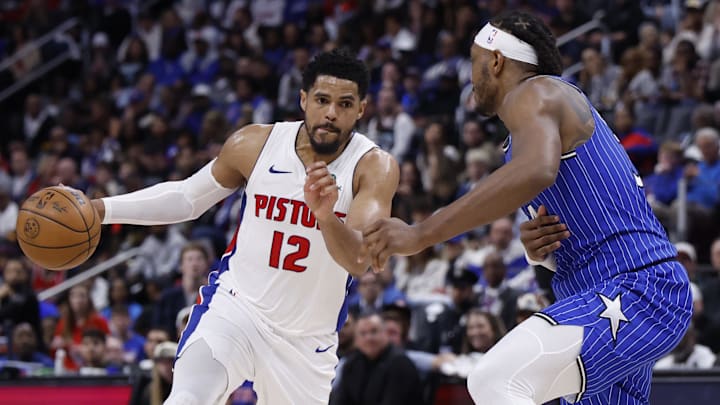
At the beginning of the series, it seemed like the Orlando Magic were comfortable with Tobias Harris taking shots. Among the compromises the team was willing to make, Harris was the player they felt they could leave and recover to.
Of course, that assumed one important thing: Franz Wagner was defending Cade Cunningham and Paolo Banchero was defending Tobias Harris.
When Wagner went out with a calf strain in the second half of Game 4, that left former two-way forward Jamal Cain to defend one of those two players at 6-foot-7.
Beyond what was lost with Wagner's offense and ability to get to the basket, the Magic had lost another key part of their philosophy and roster -- their two 6-foot-10, do-everything forwards. Few teams in the league can match up with both players when they are on the floor together. And they become a defensive problem because of their size and versatility.
That creates the Magic's advantage.
Without that advantage, the Magic looked noticeably smaller. And both Cunningham and Harris ate.
Orlando is heading home despite its 3-1 series lead after a 116-94 loss to Detroit in Game 7 on Sunday. The difference in the game came in a flurry of points late in the second quarter -- an 18-4 run that turned a tie game into a 14-point halftime lead.
Most of that came from Harris -- 11 points on 4-for-5 shooting, including two three-pointers in the final three minutes. And most of that came from him eating against Desmond Bane and Jalen Suggs in the post.
The Magic simply looked small against him and ultimately against the Pistons as they came into the series.
“Nobody can say [anything] to me about Tobias Harris," Pistons coach J.B. Bickerstaff said after Game 7. "I mean, he is dependable, reliable [and] prepared for the moment. He’s a leader, he’s a great teammate, [and] he’s a great human being. He’s a high-level competitor. To show up tonight and do what he did when it was on the line the most, it’s just exceptional. I can come up with more adjectives if you want, but I think you get my drift.”
Harris finished with a series-high 30 points on 11-for-18 shooting. He made 5 of 7 threes in Game 7 after making only 6 of 31 threes in the previous six games. That was more than enough support for Cunningham, who scored 32 points on 10-for-18 shooting and 12 assists in the clinching victory.
The Magic had no answers in the end for Harris and his versatility in the post and Cunningham and his size at point guard. After Wagner's injury, the Magic lost a lot of their advantages in the series.
A team that prided itself on his length and versatility suddenly looked small and trying to chase or junk up matchups. And that only emphasized the team's offensive issues more.
Game 7 exposed the team's flaws and where its team-building has fallen short.
The Harris matchup problem
Tobias Harris had his breakthrough shooting performance in Game 7. But Harris was a problem throughout the series -- averaging 21.6 points per game, even with a 50.0 percent effective field goal percentage.
What makes Orlando unique is that the team has two 6-foot-10, versatile forwards. Few teams have the ability to match up with both on defense and it allows the Magic to be big across the boad.
The Magic lost that size and forced them to try to figure things out. They never solved that problem. It took Game 7 for Harris to break it open.
"This is the chess match of the Playoffs," then-coach Jamahl Mosley said after Game 7. "Give credit to Tobias. He had an unbelievable game. He turned up tonight. Those are things you have to figure out as the game goes on. Those guys stepped up."
In Games 1-4, Harris shot 6 for 19 and scored 16 points in 29:12 against Banchero. He spent only 3:58 and scored seven points on 2-for-6 shooting against Bane.
In Games 5-7, Banchero guarded Harris for 14:30 minutes, scoring 40 points and shooting 17 for 28. Bane defended him for 5:12 minutes for nine points and 3-for-5 shooting. Harris found a groove the Magic could not stop.
Harris picked on Bane in Game 7 with seven points on 2-for-4 shooting against Bane specifically in 2:37.
"That's on me," Bane said after Game 7. "I got in foul trouble. I wasn't on the floor over that stretch. They were able to make shots. They got out in transition off of our bad shots and turnovers. Good teams make you pay for stuff like that."
Banchero became Cunningham's primary defender in the last two games. Cunningham feasted, averaging 36.3 points on 51.6 percent shooting in the final three games in the series as he hunted more favorable matchups without Wagner to fight over screens. Cunningham was 7 for 22 for 19 points in 17:26 against Wagner in the series' first four games.
The Wagner injury changed all of the Magic's shooting. It changed all of their size and how they could play their style.
Size is the Magic's strength
It is difficult for the Orlando Magic to copy the way they want to play with their bench. There are only so many skilled forwards with size and versatility.
A lot of Jeff Weltman's roster-building strategy has focused on finding this versatility and size and perhaps overvaluing it to a fault. The Magic never really changed the way they played based on their personnel.
The Playoffs exposed that weakness.
When Orlando lost the Franz Wagner piece in their lineup, they lost a lot of their size. Replacing him with Jamal Cain, Anthony Black or Tristan da Silva, even if they are not bad defenders, is a major downgrade. This was one area the team missed Jonathan Isaac.
That had knock-on effects throughout the roster too. The Magic lost some of their rebounding toughness and ability to keep Jalen Duren off the glass because of this lack of size.
"I've been sitting here trying to think," Wendell Carter said in the locker room after Game 7. "I think Cade got it going. I think they hit the o-boards. A couple of, in my opinion, bad boucnes went straight to them. But that's not an excuse. I think we didn't play hungry enough, in my opinion, including myself."
Orlando's size was its advantage in the series. But when the team lost Wagner, it quickly became its weakness.
For a team that is based on this philosophy, that became among its fatal weakness.
The Magic will need to reckon with this. That could mean seeking more speed and shooting off the bench, turning those bench lineups into a different style of play that can make up for a lack of size. Or it could mean the Magic need to double down on their size and accept any shortcomings that come with it.
Orlando's season came to be defined by how much the team struggled to maintain its identity around its absences. That ended up being how the season ended.
 Add us as a preferred source on Google