

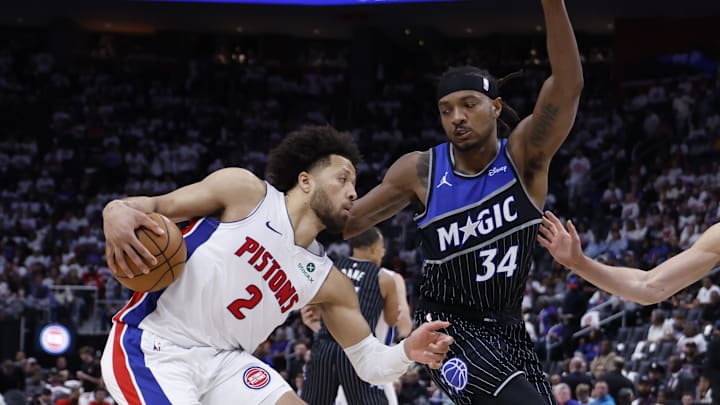
The Orlando Magic had one problem they worked around the entire series with the Detroit Pistons.
For all the advantages and everything the team did well, the Magic could not solve the paint against the Pistons. And as the series tightened up, the Magic saw their shooting numbers revert to their mean and the team could not get easy shots in the paint or make the ones they got.
Why did the Magic lose Game 6? Yes, there were a lot of misses and many open shots that would not fall. But they lost Game 6 because nothing in the paint came easy. That was the case the entire series.
In Game 6 alone, the Magic shot just 12 for 32 in the paint. They were 2 for 15 in the paint. Orlando averaged only 35.1 points in the paint per game during the series. The team gave up 42.6 per game.
The whole series was a battle in the paint. Every inch was contested. And the Pistons stood tall with several big plays at the rim -- whether it was Isaiah Stewart blocking multiple dunk attempts in the series or, despite his offensive struggles, Jalen Duren's presence around the basket as a deterrent.
It turns the Magic's attention in the offseason to the center position and a key question: Is Wendell Carter the right cetner to anchor the team to a title?
Carter has been in the spotlight all season. He seemed to be the weak link in the Magic's starting lineup. The Playoffs showed his strengths as he helped contain Cade Cunningham and bottle up Jalen Duren throughout the series.
But it also exposed his weaknesses, particularly as a rim protector. His 0-rebound game in Game 6 stood out as a frustrating data point in his inconsistent season and series. But Carter was a solid positional defender. But he was unable to make plays out of his area to lift the team defensively.
In this case, he was solid, but not spectacular.
The Magic are examining a lot of things on their roster. And the team has to be cognizant too of what is working around the league. While the Magic are a strong defensive team, their lack of above-the-rim paint protection is one of the many skills they do not have.
Carter and Magic's rim protection was merely average
Wendell Carter showed why the Orlando Magic trusted him so much throughout the playoff series.
His physicality in the paint with Jalen Duren was a key to the Magic being in the series. Carter has always been reliably in the right spots on defense and versatile enough to switch and extend to guard even elite players on the perimeter.
For as much as Carter struggled in the final games, he was a big reason the Magic were in that position to begin with. No one should discount what he did.
But the one thing Carter has never been particularly strong at is his shot-blocking and rim protection. While he is in the right spots to defend and challenge shots, teams are unafraid to attack him.
While the Magic struggled to score in the paint, the Pistons shot 54.2 percent in the paint for the series on 38.7 field goal attempts per game. The Magic's defense certainly tightened up. But paint defense was always an issue.
The team averaged 50.9 points allowed in the paint per game and 27.6 field goal attempts in the restricted are per game, the seventh-most in the league. Opponents shot 66.1 percent in the paint, 10th in the league.
Everything about the Magic's rim protection was simply average. And that starts with Wendell Carter.
According to data from Second Spectrum, opponents shot 61.2 percent on 4.2 field goal attempts per game at the rim against Carter. That put him squarely in the middle among starting centers.
Carter rates as an excellent defender individually. But he and the Magic were clearly missing something.
Putting on top of that, Carter often let mistakes compound, a flaw Carter has often talked about needing to improve, and Carter's lack of rim protection, it has the Magic pondering a move for their future.
Orlando played a strategy of defending well around the paint and the rim. And the Magic were simply average at it.
Every team remaining has a shot-blocking center
The Orlando Magic must be cognizant of trends around the league.
The six remaining teams in the Playoffs all have something in common -- strong rim protection and shot blocking.
Five of the top six teams in defensive field goal percentage at the rim are still alive in the Playoffs, led by the Oklahoma City Thunder at 59.4 percent. The Los Angeles Lakers at 29th with 70.3 percent, were eliminated quickly in the second round.
The Magic were average at this mark, giving up 66.2 percent at the rim this season. They gave up 61.1 percent in the series with the Detroit Pistons, good for fifth in the Playoffs so far.
Orlando also ranked 17th in the league in blocks per game at 4.7 per game (down from first in 2025 at 6.0 per game). Four of the top eight teams in blocks per game are still alive in teh Playoffs.
Similarly, all the teams remaining have a heavy usage center ranked ahead of Wendell Carter in defensive field goal percentage at the rim. The entire top five are still alive in the Playoffs -- Chet Holmgren, Jarrett Allen, Isaiah Hartenstein, Victor Wembanyama and Rudy Gobert.
These are obviously elite shot blockers. And Wendell Carter sat just behind Jalen Duren in the regular season rankings.
But in the Playoffs, Jalen Duren is allowing 54.4 percent shooting at the rim (48.6 percent in the series against the Magic). Carter was at 62.5 percent. A solid number that ranks ninth among centers who played at least 24 minutes per game in the first round. But hardly an improvement for an otherwise average rim protection team.
As much as the Magic need spacing to the 3-point line offensively. The team is also looking for more vertical spacing. They are looking for players who can play above the rim and challenge shots more effecitvely at the rim.
That is a key missing element that all the teams contending for a title seem to have. And it is something that Carter may not be able to fulfill.
 Add us as a preferred source on Google