

Whenever you think of the Orlando Magic for the past four seasons, one thing always comes to mind.
their effort and defensive intensity.
The Magic may not have had the offensive weapons to win every night, but opponents would feel them in the morning. They would need every ounce of energy to defeat the Magic. Orlando was not going to go away or go quietly.
And sometimes that effort alone would be enough to win. It was an identity the Magic could lean on.
Droughts and inconsistency on offense seemed to matter less because the defense and that intensity and effort were always there.
You always learn more about a team when things are hard than when they are easy. The Magic might have had flaws, but you could always count on them to play with that intensity.
This year's Magic? Increasingly, they have struggled to find that identity. They have struggled to lean on their defense. They have struggled to be the hardest-working team.
That was again the case in Friday's 121-114 loss to the Chicago Bulls. The Bulls made major runs and answered every push from the Magic. They outworked Orlando on the glass at key moments and found it far too easy to score.
The Magic again could not get critical stops or make shots in the fourth quarter to pull away. They were constantly on their back foot. They were chasing instead of being the ones overwhelming an opponent effort.
This was once again not Magic basketball.
And while there is certainly hope that the impending return of Franz Wagner and Moe Wagner can help right the ship -- Jalen Suggs went out late in the third quarter with a strained right knee after a hard fall -- Orlando is still trying to rediscover the identity that made them such a tough out the last few years.
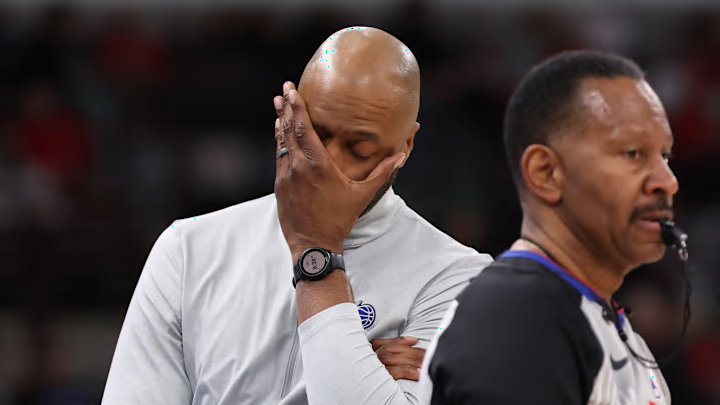
The Magic better find a fix and fast, even with a favorable January schedule. Orlando is losing the identity that made it special. And it is the biggest crisis that coach Jamahl Mosley and his team are facing.
Orlando is nothing without that identity.
Another collapse
The Orlando Magic's frustrations were once again on full display in the fourth quarter.
In a back-and-forth game that saw each team put runs against the other, the game was still in the Magic's control with a four-point lead. They needed to be the aggressors to finish the game out.
Instead, from the jump the Bulls were the far more aggressive team. They got four fouls on Jamal Cain in the quarter and entered the bonus with 9:44 to play thanks to a pair of fouls on Cain and one possession that featured three foul calls on the Magic.
That push tied the game at 100 with 9:01 to play and forced coach Jamahl Mosley to put his starters back in.
But even that did not relieve much tension. As has been the case in several fourth quarters recently, Orlando went suddenly cold, even after making 14 threes and being on as big an offensive tear as Chicago was on to take the lead.
The Magic went three for 10 from the floor in the next six minutes, falling behind by seven points. They had two turnovers, both on poor decisions from Paolo Banchero trying to force his way to the paint after an otherwise stellar 31-point effort. Down three with 1:23 to play, Desmond Bane missed a pair of three-pointers.
Tre Jones iced the game with a tough jumper over some finally strong defense and made it a five-point lead.
"They came out, and they went on multiple runs," Mosley said after Friday's game. "Those were the things we have to continue to communicate and to talk about and show that basketball is a game of runs. You have to keep the same poise and same demeanor when teams do go on runs. I think that's a big key for us as we continue to move forward."
Quite simply, the Bulls made the plays to take control with a 31-19 fourth quarter. The Magic once again struggled to close the game out in the fourth and could not recapture any of their clutch heroics.
They missed a lot of shots and made a lot of poor decisions that the Bulls pounced on with their fast-paced offense.
That has become par for the course of late.
Outworked, outhustled
None of that may have mattered if the Orlando Magic were sharper on defense.
Their struggles on defense remain the most puzzling and concerning thing. It has become a repeated and frustrating facet of this team, something that only rarely happened in the last three years.
The Bulls posted a 122.2 offensive rating, marking the 10th time this season the Magic have given up 120.0 points per 100 possessions or more in a game. Orlando gave up that many just eight times last year and just 14 times in 2024.
Something this basic to the team's identity has become a hindrance. It is something the team is not relying on. And it is costing them games.
"We just didn't get any stops," Anthony Black said after Friday's loss. "They got in transition, they got threes up. They got whatever they wanted. Just not playing good defense at all recently."
What is more frustrating is it has come down to the effort plays.
Chicago grabbed nine offensive rebounds for 14 second-chance points. At times, the Bulls beat the Magic to contested rebounds just on pure effort alone. It was hard to say the Magic were the hardest working team, especially in that fourth quarter.
Even something as reliable as the Magic's 3-point defense came under fire. Chicago made 14 of 41 3-pointers, matching Orlando's hot 3-point total. The 41 attempts were the second most the usually stingy Magic defense has given up all year.
In the fourth quarter, the Magic were on their back foot. And when the shots stopped falling as they had all game to that point, the Magic had nothing to lean on. Not their effort, not their defense, not their identity.
That has become an all-too-common refrain for the Magic. They have spent many postgames puzzling over their sudden offensive stagnation -- the inability to force turnovers or get stops, forcing them to go up against half-court defenses gaining confidence and tightening their grip -- and puzzling over their poor defense.
They have done so much wondering, it is beginning to feel like this is who the team might be.
The Magic are nearly halfway through their season. If this is not the identity they want, then it is up to them to change it and up to the coach to foster that change.
 Add us as a preferred source on Google