

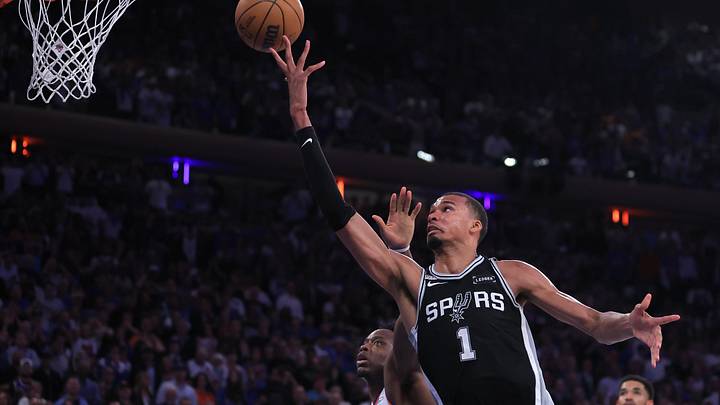
Everyone in the basketball world is trying to figure out what happened in Game 4 of the NBA Finals.
The San Antonio Spurs were so dominant in the first half, building as much as a 29-point lead and hitting an NBA Finals record 14 3-pointers in the first half. It seemed like the Spurs had figured the New York Knicks out at last to tie the series with two road victories.
So how are we sitting here talking about a Knicks win after an OG Anunoby tip-in with 1.2 seconds left? How are we talking about the largest comeback in NBA history and a defeat that is surely as gutting as any in NBA Finals history for a young team?
And why does this feel so familiar?
Orlando Magic fans know exactly what the San Antonio Spurs are going through. And the Magic's new coach, Sean Sweeney, just experienced what the Magic have had to live with all offseason.
The Spurs' losing a 29-point lead was too painfully similar to the Magic's 24-point collapse in the second half of their Game 6 loss in the first round.
When Sweeney arrives in Orlando, he may carry the same scars and frustrations into the offseason as the team he is taking over.
Anatomy of a collapse
What was certainly disorienting, watching the San Antonio Spurs fall apart, was how similar it felt to the Orlando Magic's collapse.
The Spurs did not miss 23 straight field goals, and they scored more than the NBA Playoffs-worst 19 points the Magic scored in the second half of that Game 6. But much of the process and many of the issues felt similar.
Like the Spurs, the Magic shot an uncharacteristic 7 of 18 from three in the first half. They made 56.1 percent of their shots overall but had just 20 points in the paint in building a 60-38 lead. Their defense was hounding, and the Magic were making shots to build their lead.
The Spurs did much of the same to get on top in Game 4.
But San Antonio started to slow down and try to bleed the clock. The ball stopped moving. And the shots that fell in the first half no longer went in.
San Antonio shot 8 for 39 (20.5 percent) in the second half and only 3 of 17 from three. The Spurs had 10 turnovers in the second half after just two in the first half.
The Spurs led by 29 with 9:40 to play and then gave up a 23-9 run to end the third quarter to cut the lead in half to 15 points.
The Knicks did not take the lead until 1:22 to play. They outscored the Spurs 32-16 in the fourth quarter and 58-30 in the second half.
That is similar to the Magic's collapse.
The Orlando Magic scored far fewer points at 19, and played a far worse offensive team in the Detroit Pistons. But the problems were all the same. The Magic's offense got stagnant and slow. They started forcing things and could not find any relief to rebuild confidence and momentum.
The Magic shot 4 for 37 (10.8 percent) and 2 for 18 (11.1 percent) from three in the second half. They had seven turnovers. The 23 straight missed field goals buried them in a hole.
That started after they hit back-to-back threes to go up 16. The Pistons cut that lead to nine by the end of the third quarter. The Pistons needed only five minutes as the shots piled up to take the lead for good.
Like the Knicks in Game 4, once the ball started rolling downhill, you could feel the offense get tighter. You could feel the Magic get tighter in Game 6 as the shots missed. There was no way to break the spell.
How do you move forward?
The Orlando Magic still had a Game 7 to play to try to save their season, just as the San Antonio Spurs still have a Game 5 at home to extend the series and live to fight another day. In the end, both teams had their chances to win despite the struggles throughout the second half.
But undoubtedly, the air in Little Caesars Arena felt heavy around the Magic. It was an emotional letdown being unable to close the series out at home and suffering a historic loss.
The Magic got a 38-point effort from Paolo Banchero, but a confident Pistons team put on a killer 20-6 run to close the second quarter, and the game was over.
Emotions are certainly fragile. How the Spurs respond will speak volumes.
They have played from ahead in all four games of this series. Each time, the Knicks responded and gave themselves the chance to win. They have often taken it.
Beyond this year, the Magic must be wondering what coach Sean Sweeney is learning as an assistant.
He has successfully shifted defenses to slow down a stellar Knicks offense. Yet, New York keeps finding ways to break this team down. They adapt and adjust quickly -- a credit to their offensive weapons and to coach Mike Brown, who adjusts on the fly himself.
Sweeney is surely feeling the emotions of another devastating loss.
Coaches can only put players in a position to succeed. It is still a team effort to solve all of these problems. And ultimately, Sweeney is an assistant coach. The head coach takes on the main responsibility.
Still, Sweeney and the Magic will have to sort through what it was like to lose massive leads in big spots. They will both have to learn and apply the same lessons and find a solution to stop their offense from hitting that extreme of a rut.
Sweeney is known as an intense and focused coach. It will be his job the next time he and the Magic are in a position to close out a big game to keep the foot down and not relax or settle. Nobody can leave the door open again.
That is the ultimate lesson. And now both the Magic and Spurs have learned it the hard way.
 Add us as a preferred source on Google