

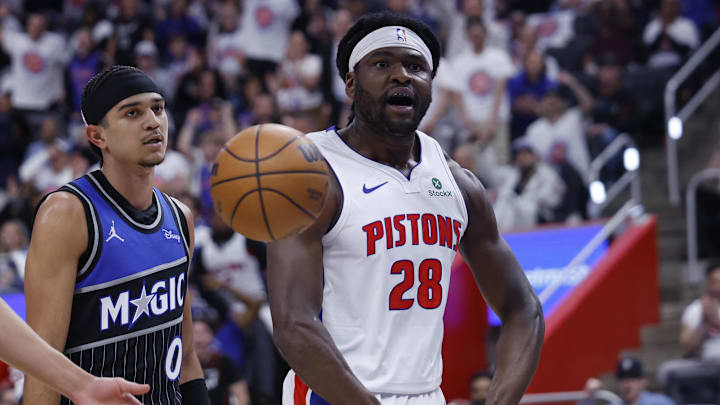
DETROIT -- The conversation around the league after the Orlando Magic's 112-101 Game 1 victory was whether the Magic had put the Detroit Pistons in a true bind.
Even with the Pistons' hammering defense -- playing decently in Game 1, but hardly elite -- the Magic's size seemed to give them issues. There are still many questions Orlando seems to ask Detroit.
But Detroit has a big question to ask Orlando: What happens when we turn up the intensity? What happens when we start to fly around and spook shooters into passing up shots? What happens when you make the mistakes we want you to make?
The Pistons showed the Magic why they are the top seed and a heavy favorite in the series. They showed why the Magic finished as the 8-seed.
Detroit's 30-3 run was a statement of the team's defensive intensity and intent and a statement of Orlando's lack of offensive cohesion and confidence. The Pistons pounced on mistakes and built momentum quickly as the Magic allowed errors to snowball.
In a series that the Magic virtually have controlled or played to their liking in seven of eight quarters, the Pistons reminded the Magic how one strong defensive quarter can change everything. This is still their series to win.
"We just played defense," Pistons coach J.B. Bickerstaff said after Game 2. "It’s that simple. When we play defense at the level we’re capable of, it triggers everything for us. We can be an elite defensive team, a disruptive defensive team that pushes, and get us transition easy baskets, and that’s what we did."
The 30-3 run was a trainwreck for the Orlando Magic, and awfully familiar to the Toronto Raptors' 31-0 run in March that led to a 52-point loss. In a Playoff game, a run of that magnitude is simply too much to overcome.
The Magic are still susceptible to these long scoring droughts and the turnovers and mistakes did not allow their defense to get set and give them a chance to regain their footing.
What makes the Pistons so good is that they have a defense that does not allow anybody to get comfortable.
Detroit has flexed its defensive muscle
The Orlando Magic were under no impression that scoring would be easy in this series. Everyone understood that this series was going to be a war of attrition, and whoever took advantage of the lax moments for either team would be the one who won.
The Magic blitzed the Pistons early in Game 1 to get out to a 13-point lead and essentially held on from there, batting off runs from the Pistons by playing controlled defense from the lead.
Orlando's 113.1 offensive rating in Game 1 was an oulier for Detroit.
Detroit finished second in the league in defensive rating, giving up 108.9 points per 100 possessions. The Pistons were fourth in the league, giving up 43.7 points in the paint per game and third in the league, giving up just 30.4 field goal attempts per game in the restricted area (and 50.4 field goal attempts per game in the paint).
The Pistons led the league with a 16.8 percent turnover rate and second with 21.5 points off turnovers per game.
This is a tough-nosed defensive team. And for most of this series, the team had not lived up to that billing.
"We knew that the first half wasn’t to our standards of playing, and we had to really figure out defensively how we were going to impact the game," Tobias Harris said after Game 2. "I thought we came out with just the type of energy and the type of effort that we need on [the] defensive end. . . . Obviously, as you know, we’re able to get stops and get out in transition. That’s when we’re at our best, and I thought we did a great job of that."
The Pistons won all of these categories, particularly in the third quarter.
In Game 2, Orlando ended with its lowest point total of the season with 83 points -- 83.8 points per 100 possessions. The team shot only 17 for 39 in the paint and just 8 for 18 in the second half. Orlando committed 19 turnovers for 18 Detroit points, including seven for nine in the third quarter.
That third-quarter run was the Pistons flexing their muscles and proof the Magic cannot lose focus or they will be in big trouble.
Defense is an attitude
What is clear is that defense is where the winner will gain its confidence. Through two games, the story has been about which team has the most swagger on that end.
Neither team is consistent or good enough offensively to get its energy from its shooting. That is not who these teams are. Both want to carve their identity from their defense.
There is no player where that is clearer than Isaiah Stewart.
Stewart's role is to mix things up defensively and charge his team and the home crowd.
He did that in Game 1 with a block on Paolo Banchero at the rim. He did it again in Game 2. And those plays set the tone for the Pistons. Those are the plays that energize a team to do the dirty work defensively.
"That's who I am," Isaiah Stewart said after Game 2. "I don’t have to fake it. I'm cut from that cloth. Everybody who knows me knows that’s just who I am. I don’t feel that weight because it's just who I am. I enjoy carrying the identity for this team. That’s what I was drafted here for, and to hear J.B. say that [I embody that identity] and to see it come to light is just great."
Stewart finished with 10 points and five rebounds, a huge contribution of the bench after everyone outside of Cade Cunningham struggled in Game 1. The Pistons had a 91.2 defensive rating with Stewart on the floor. And his two blocks were part of 11 total blocks from Detroit.
The Pistons' defense led the way in that critical third quarter. That hounding, pressure defense that took the Magic off their spots and made them second-guess their looks and reads is what everyone expected from the Pistons.
Orlando's inconsistency on offense always made that potential from Detroit the most dangerous aspect of the series.
The Pistons reminded the Magic of that fact. Orlando will no have to solve and brace for these frenetic moments and not lose grip.
 Add us as a preferred source on Google