

Two weeks ago, the Orlando Magic were having a first-half party.
They were on the brink of eliminating the top-seeded Detroit Pistons and advancing in the Playoffs for the first time in 16 years. The Kia Center was at full throat and everything was working as the Magic took a 22-point lead to the locker room.
Everyone knows what happened next. It is a frustration that will live with the team throughout the offseason and probably until they exorcise those demons and win their first playoff series.
The Magic lost Game 6 93-79, scoring only 18 points in the second half and missing 23 straight shots. It was a measure of offensive futility that the league has not seen, certainly not in the modern era.
It was a reminder of the team's shortcomings and weaknesses and how far the Magic are from being a title contender.
The first response from the Magic was to recognize first what a gut punch that loss was. The team was a bit shell-shocked.
Then president of basketball operations Jeff Weltman argued that the team showed in going up 3-1 that the Magic were not as far as it might have felt at the end of the series. When healthy, this team was not only competitive but elite enough to defeat a 60-win Pistons team.
The Magic already made one change, dismissing coach Jamahl Mosley. Meanwhile, the Detroit Pistons continued to play out their second-round series against the Cleveland Cavaliers. And the Pistons continue to make the Magic look a little bit better.
They pulled their magic trick again.
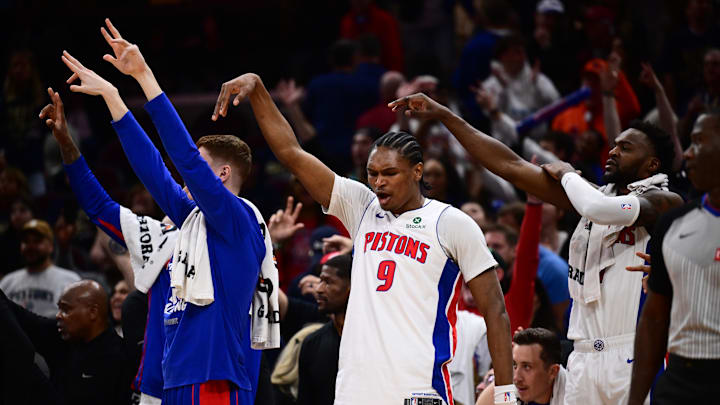
Detroit faced elimination on the road in Game 6 for a second time these playoffs and came through with a 115-94 victory to force a Game 7 on Sunday. The Pistons showed how unflappable they are. And they showed that even against a seasoned Cavaliers team, they are not going down easily.
Cleveland did not hit the lows Orlando did, but the second half was mostly non-competitive with Detroit winning 61-43 (Detroit outscored Orlando 55-19). That the Pistons did this again shows the Magic may not be as far as they think. Detroit is doing this to everyone, and the margins in the Eastern Conference are not very wide.
The Magic had a lot of successes vs. the Pistons
The central argument the Orlando Magic made was that the team took a 3-1 lead because they were finally healthy.
The Magic's starting lineup, when fully healthy, was one of the best in the league anyway. But in the series, the lineup of Jalen Suggs, Desmond Bane, Franz Wagner, Paolo Banchero and Wendell Carter had a net rating of +14.7 points per 100 possessions (115.5/100.8 offensive/defensive rating).
If the Playoffs are about getting your five best players against your opponent's five best players, the Magic won those minutes. Through the first four games, the Pistons' starting lineup, which was the league's best heavy-usage lineup for the entire season, posted a -0.2 net rating (110.3/110.4) -- that group went +41.9 points per 100 possessions with a 88.7 defensive rating in the final three games.
It is probably unfair to say Wagner's injury had such a big impact. But it was the story for the entire season, keeping the Magic from escaping the Play-In and ultimately costing them in the Playoff series.
Without Franz Wagner, Cade Cunningham ran wild on the Magic's defense, and the Magic were unable to adjust.
But that speaks to how close the Magic were. Orlando seemed to play the way everyone imagined they would in the preseason through the first four games.
It was not crazy to think Orlando could have pushed and defeated Cleveland to reach the conference finals with how well the team was playing defensively -- even though Cleveland presents many more defensive challenges with its shooting and its interior size.
The winner of the Magic-Pistons series was certainly battle-tested, and that has played out as the Pistons rallied to get to a Game 7.
The team's flaws remain undeniable
Still, it is undeniable that the Orlando Magic were rightfully the 8-seed and fell well short of its preseason predictions. The team had a 22-point halftime lead and a nine-point lead heading to the fourth quarter at home in a closeout game. There is very little excuse for losing that opportunity.
The problems were not just about Franz Wagner's injuries and his absence.
Even with Franz Wagner out, Paolo Banchero, Desmond Bane and Jalen Suggs should have been enough to win the game. The team certainly should have scored more than 19 points in a half and eight points in the fourth quarter.
But none of those problems were new or that surprising.
Orlando has not had an offense in the top half of the league since Dwight Howard in 2012, and that is even with the team they have now and the offensive weapons they believed they had.
In the end, the Orlando Magic are sitting at home instead of playing in Game 6 on Friday or preparing for the New York Knicks in the Eastern Conference Finals because they cannot hit a shot and they blew too many leads.
Orlando needs a more consistent way to attack. That is something they hope a new coach can provide.
It did not help that so many things about this team were off from the injuries throughout the roster -- in addition to Franz Wagner missing the last three games with a calf strain, Anthony Black was playing while recovering from an abdominal strain, and Paolo Banchero never looked physically right all season.
Still, the Magic never could get everything together. The result of Game 6 was surprising only for the depth of the struggles. But Orlando lost leads all season long. The team lost a 16-point lead in the fourth quarter of Game 3.
Orlando must improve the roster to eliminate that doubt and that weakness. The defense and its stars need better support and space.
The margins in the NBA are always incredibly small. And in this age of parity brought on by the new CBA, the difference between winning as an 8-seed or getting homecourt advantage is incredibly small.
Orlando is much closer than it appears. But the team is still far away.
That the Pistons pulled off another Game 6 to avoid elimination proves that the Pistons have all the margins the Magic were missing in the end.
 Add us as a preferred source on Google