

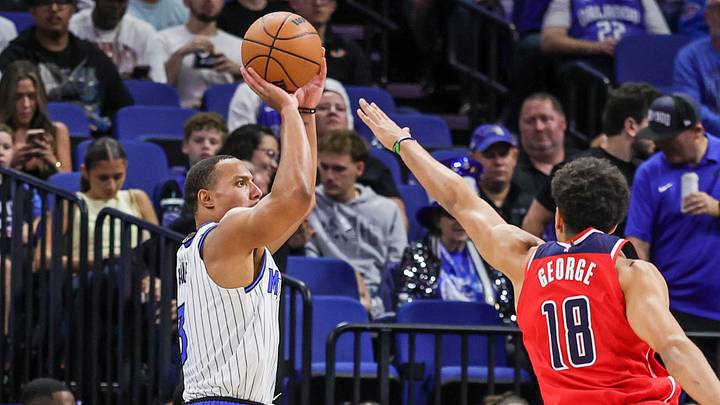
Orlando Magic coach Sean Sweeny espoused that his new Orlando Magic team would value and emphasize spacing. The 3-pointers would follow.
From the moment the Magic took the floor in the preseason, it was clear that something was different about this offense. Everyone could see the boost in three-point attempts as the clearest sign that something was different. They could see it from the open threes.
There is no correct number of 3-pointers for the Magic to take. Sweeney said the goal is to get the best shot, no matter what it is.
But the Magic are getting them up in droves.
Getting them up. . . too much?
The Orlando Magic took 39 3-point attempts in Tuesday's 103-94 loss to the Washington Wizards. That is 39 of the team's 80 total field goal attempts.
That is a change in volume. But what has not completely changed is the Magic's inconsistency making those shots. And that inconsistency, despite the quality, is costing the Magic games and cratering their offense.
Right now, the 3-pointer is all the magic have. It has not been reliable.
After making 6 for 11 in the first quarter, the Magic made just two of their next 20 from deep. The Magic finished 11 for 39 from three, going five for 28 (17.9 percent) in the final three quarters.
If that is half of their attempts, then the question becomes: What else can they do? Are the Magic this dependent on 3-point shooting?
"I think our offense starts with aggressiveness, touching the paint, and we believe once we touch the paint, whatever comes from there is usually going to be a good possession for us," Desmond Bane said after Monday's loss. "I think as long as we are keeping that process, we're being aggressive, getting two feet in the paint and making sound decisions, we can live with the results. We've got guys who can shoot the ball well, and we'll continue to."
Orlando has two games shooting better than 40 percent from three. Those are the two games the Magic have won. The team has three games shooting worse than 30 percent from three.
The Magic are taking a lot of threes. The question is whether this is the right number for them.
Increasing 3-point volume
Considering the Orlando Magic actively avoided 3-point attempts for much of Jamahl Mosley's tenure because of how poorly they shot from deep, this is a dramatic change in their strategy.
Orlando is now 14th in 3-point field goal attempts per game at 38.3 per game -- after shooting only 34.1 per game last year. The Magic have made 34.3 percent from three this season -- dropping from 11th entering Monday's game to 18th in the league in percentage.
The quality of these looks is also quite impressive.
Orlando is 11th in the league with 19.0 "wide-open" 3-point attempts per game. That accounts for 49.6 percent of their total 3-point attempts. The Magic are 20th in the league, making 36.1 percent of those attempts.
Orlando's game Monday fell apart because of that nine-point third quarter that saw the team shoot 1-for-13 from three. For the game, the Magic were 5-for-17 on wide-open threes, a tick below their season average (it was a very low-possession game). In the third quarter, the team was 0-for-7 on those attempts.
The Magic are not exactly complaining about their process if this is the case.
"We always want to attack the rim and attack the paint," coach Sean Sweeney said after Monday's loss. "They did a good job just, in general, trying to cut that off. I think a number of the good looks were from a guy in Tristan da Silva . . . that we all know can shoot the basketball and didn't quite have as good a game today. Nothing changes with how we want to play. We want to attack the paint and look to make the right decisions from there."
There is plenty of argument that if the Magic had hit one of those shots, they would be playing a different game. Especially with how well the defense held up.
The question is whether any of this is actually better for the Magic. Are they just shooting the same poor percentage on higher volume?
More startlingly than the per-game numbers, the Magic are taking 46.9 percent of their attempts from three this year. Last year, it was 38.6 percent of their total attempts.
That is a dramatic difference. And that kind of volume demands other parts of the game remain efficient.
Instead, Orlando is struggling to fill in the rest of the offense. The issue facing this team is that the 3-pointer is the only option.
Diversifying the offense
The frustration that has grown as the Orlando Magic's offense continues to run into a wall is just that: The Magic are struggling to get into the paint.
The Magic's offense was previously built on their ability to get to the paint and force their way to the line. That is how the Magic often made up for their lack of 3-point shooting.
They were second in the league last year with a 31.1 percent free throw rate and 13th with 51.1 points in the paint per game last year. This was hte basis for so much of their limited offensive success.
This year, they are 23rd with 43.7 points in the paint per game and 15th in free throw rate at 29.0 percent.
The Orlando Magic took only 10 free throw attempts in Monday's loss to the Washington Wizards. They scored 48 points in the paint on 24-for-34 shooting, winning points in the paint for just the second time in seven games.
The Magic have taken the sixth fewest field goal attempts per game within 10 feet at 34.0 per game. Last year, they were seventh with 41.0 field goal attempts per game within 10 feet.
If getting to the paint is a priority to set up the spacing and outside shooting, the Magic are struggling to complement it with consistent attacsk at the rim.
"I think generally, as a team, get more to the paint, play inside-out and create better looks that way," Nikola Vucevic said in the locker room after Monday's loss. "They did a pretty good job defensively pressuring us and getting us out of our things. It is something we have to figure out."
It is not for lack of trying. The Magic are fourth in the league with 73.3 drives per game, according to data from Second Spectrum. They take 25.0 field goal attempts per game and shoot 52.6 percent on drives, both within the top half of the league.
But everything comes back to the 3-point shot for the Magic. It has become so central to what the Magic do that when it goes in, everything works. When it does not, everything becomes a struggle.
The Magic seem too dependent on it now. They need to find a better balance. They cannot keep firing and missing and expect to win.
 Add us as a preferred source on Google