

Entering the week, there were about five or six moves remaining before the NBA could go into full hibernation.
Most of those dominoes remaining in the NBA's offseason belonged to the same category of transaction -- restricted free agency.
Two of those dominoes finally fell this week when the Cleveland Cavaliers acquired Peyton Watson in a sign-and-trade deal with the Denver Nuggets. That finally allowed the Cavaliers to sign James Harden to his new deal.
The last pieces to this offseason -- now that DeMar DeRozan has found a new home with the Denver Nuggets and Klay Thompson is set to join the Miami Heat after securing a buyout -- are restricted free agents Jalen Duren, Jonathan Kuminga and Bennedict Mathurin. They all have until Oct. 1 to sign the qualifying offer and stay on their teams for the upcoming season, becoming unrestricted free agents.
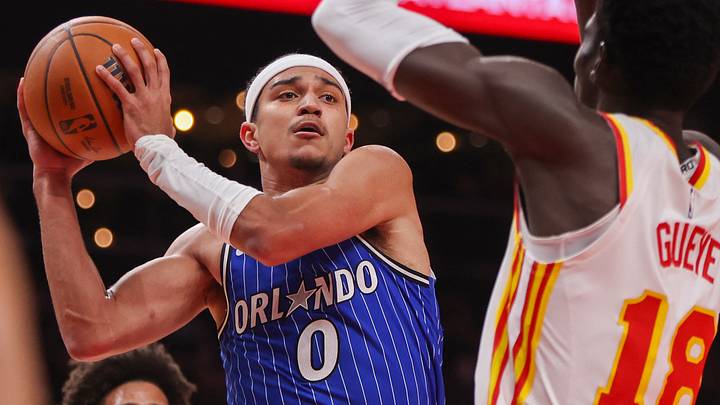
These are developments that Anthony Black, his representation and the Orlando Magic are all watching very closely.
Like at least a few of these players, the Magic are turning off the funnel of extension money with concerns about dancing around the first and second apron. The Magic, for the first time under Jeff Weltman, may be playing hardball with one of their young players.
There will be a lot of lessons to learn from this year's restricted free agency.
Restricted free agency in stasis
The biggest trend that seems to have set in this offseason is that restricted free agency has left a lot of quality players in stasis.
Restricted free agency is a vital tool. It ensures that teams that invested in the growth and development of a player have some protection to get the best years with that player after they come off their rookie contract.
But the new apron rules have also trapped these players.
The Denver Nuggets have been desperate to avoid the second apron. But they also could not really afford to let a young player like Peyton Watson leave.
Teams were hesitant to make any offer to him, knowing the Nuggets would likely match.
Denver ultimately found a deal to move him along, recouping some draft assets. Watson agreed to a three-year, $64.5 million deal with the Cleveland Cavaliers to end this saga (with the Cavs doing some cap gymnastics to get the deal done).
That leaves only Jalen Duren, Jonathan Kuminga and Bennedict Mathurin to sign contracts and find long-term homes.
All of these players are NBA-level players. More than that, they are all clear rotation players who have helped teams in playoff runs through the early part of their careers.
It is odd that they have not been able to find homes.
They will at least sign the qualifying offer. And as the summer has waned, they will find some suitors willing to take the risk or work a sign-and-trade to give them long-term homes.
This is a saga that is playing out more and more. Only this summer has brought it more clearly into focus as a clash between old contract structures and how teams are acting under the new aprons.
The next test will almost certainly be Anthony Black.
A preview of things to come?
It is not that massive extensions are not being signed.
In the 2022 draft class, Paolo Banchero, Chet Holmgren, Jabari Smith Jr., Keegan Murray, Shaedon Sharpe and Dyson Daniels all got extensions. These are all benchmarks that the class of 2023 will use.
What has been odd this summer is that there have been virtually no extensions for players coming off their rookie contracts. Victor Wembanyama is the only member of the class of 2023 to sign an extension.
But what has become clearer is that extensions are only going to players that teams are completely sure about. It stands to reason that Brandon Miller, Amen Thompson and Ausar Thompson will all get extensions before the deadline. Cason Wallace and Bilal Coulibaly also will probably get their deals too.
There will certainly be more signed before the October deadline. But Black is still trying to prove himself.
He had a breakthrough 2026 season, averaging 15.0 points per game. He took some major scoring leaps and is reliable on defense. But it was also his first year averaging more than 10 points per game in his three-year career.
It was a proof of concept and not quite assurance of future production.
Considering the Magic are dancing around the aprons, they likely cannot give him some huge guaranteed contract. Probably not what he and his representation are looking for.
Black is much more similar to the players who are waiting out restricted free agency. How their contracts get resolves will determine a lot of Black's potential.
During the peak of his run in December, Zach Lowe predicted that Anthony Black would seek the same contract that Jalen Suggs received. More likely, the benchmark his representatives are looking for is Dyson Daniels' four-year, $100 million deal.
His value could come anywhere from the low-$20 million range to just shy of $30 million.
Daniels averaged 14.1 points per game in the 2025 season, the summer before he signed his extension.
Similarly, Bennedict Mathurin has a career average of 16.2 points per game and proved to be a strong scorer for a championship-level Indiana Pacers team before his trade to the LA Clippers.
Jonathan Kuminga struggled to break into a veteran Golden State Warriors lineup, but topped out at 16.1 points per game in the 2024 season. He averaged 12.3 points per game in 16 games with the Atlanta Hawks last year.
Both of these players are likely looking for contracts that inflate their role. That may be part of what has led to this stalemate. But Black should be in line to get a contract similar to these players.
That is why the Magic and Black are eagerly waiting to see how these negotiations play out.
Jeff Weltman has a reputation for taking care of his players. Even if the Magic and Black do not reach an extension before the deadline, it would be easy to see Black proving himself and backing up his strong 2026 season and the two sides coming to an agreement next summer.
The extension deadline is not the end of the story.
But it is a new era for restricted free agents. Especially if their place on their teams is uncertain. Black is not quite at this level, but he needs another year of growth to avoid the purgatory restricted free agency has become.
 Add us as a preferred source on Google